

White Elephant is a gift exchange game where everyone brings one wrapped gift, players take turns either opening a new gift or stealing one that’s already been opened, and a steal limit keeps the game from going on forever. It’s a staple of office holiday parties, family Christmas gatherings and friend groups across the US, and it goes by other names too, including Yankee Swap and Dirty Santa.
The basic idea is simple, but groups argue every year about the details: Can you steal a gift right back? When is a gift “frozen”? Does the first player get another turn? This guide covers the classic white elephant game rules step by step, the most common house rules, and popular variations like the dice version, so your group can agree on the rules before the first gift is opened.
White Elephant at a glance
| Detail | What to know |
|---|---|
| Players | 6 or more works best; 10–30 is the sweet spot |
| Ages | Any age; kids can play with a parent’s help |
| You need | One wrapped gift per player, numbered slips of paper |
| Time | About 30–60 minutes, depending on group size |
| Goal | End the game holding a gift you like |
Key White Elephant terms
- Steal: Taking an opened gift from another player on your turn instead of opening a new one.
- Freeze (or “dead” gift): A gift that has reached the steal limit. It can’t be stolen again and stays with whoever holds it.
- Steal limit: The number of times one gift can be stolen before it freezes. Three is the most common house rule.
- No steal-backs: A player whose gift was just stolen can’t immediately steal that same gift back.
- Final swap: An optional last turn for player 1, who never had a chance to steal.
How to set up a White Elephant gift exchange
- Agree on a spending limit ahead of time so gifts feel fair. Also decide whether gifts should be useful, funny or themed.
- Have everyone bring one wrapped gift with no name or tag on it, so no one knows who brought what.
- Put all the gifts in one pile in the middle of the room or on a table where everyone can see them.
- Write numbers on slips of paper, from 1 up to the number of players, fold them and let each player draw one. That number is their turn order.
- Announce the house rules before you start, especially the steal limit, whether steal-backs are allowed and whether player 1 gets a final swap. Settling these up front prevents most arguments later.
- Seat players in a circle or rows so everyone can see each gift as it’s opened.
White Elephant game rules: how to play, step by step
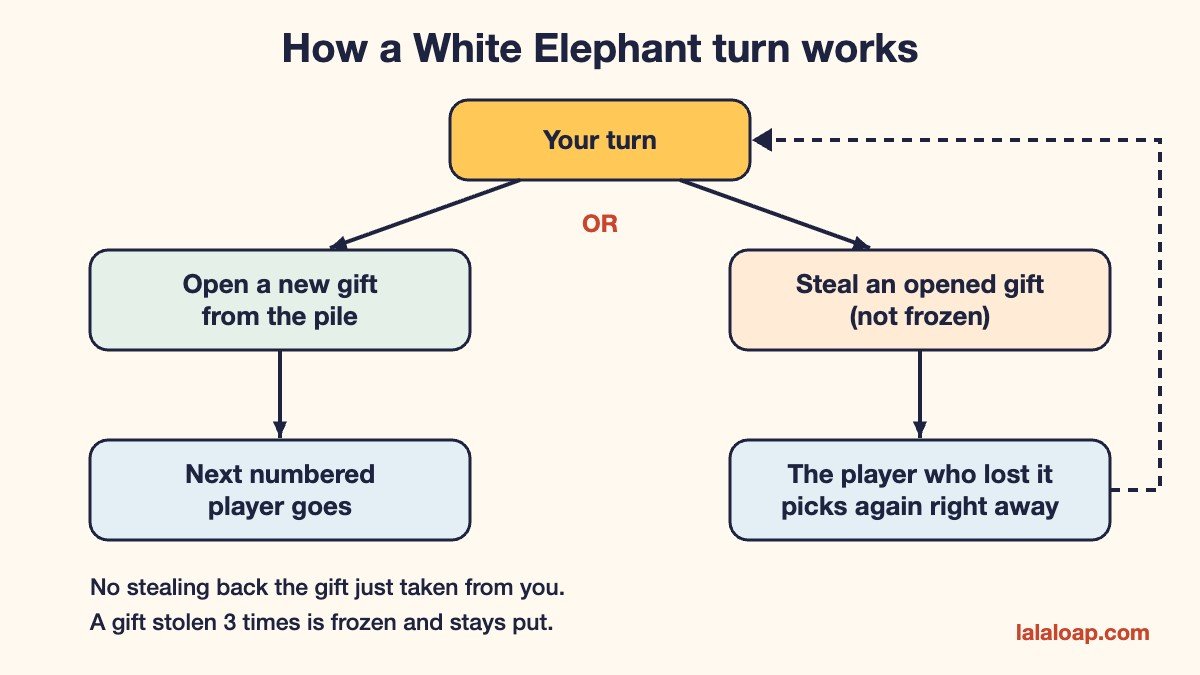
- Player 1 goes first. They choose any wrapped gift from the pile and open it so everyone can see it. Since no gifts are open yet, player 1 can’t steal.
- Player 2 makes a choice. They can either open a new gift from the pile or steal player 1’s opened gift.
- If a gift is stolen, the player who lost it immediately gets a new turn. They may open a new gift or steal a different opened gift, but they can’t steal back the gift that was just taken from them.
- The steal chain continues until someone opens a new gift from the pile. Then the next numbered player takes their turn.
- Every player takes a turn in number order, choosing to open a new gift or steal an opened one that isn’t frozen.
- When a gift is stolen for the third time (or whatever limit you chose), it freezes and stays with the player who just took it.
- Optional final swap: After the last player’s turn, player 1 may swap their gift for any unfrozen gift in the room, since they went first and never had a chance to steal. The player who loses a gift in this swap takes player 1’s gift.
- The game ends when every gift has been opened, all turns are done and the final swap (if you use it) is complete.
How does stealing work in White Elephant?
Stealing is what makes White Elephant fun, so it helps to agree on these points before you begin.
How many times can a gift be stolen?
Most groups use a three-steal limit: once a gift has been stolen three times, it’s frozen, and the third person to steal it keeps it. Some groups count the first opening as one “touch,” which freezes gifts faster. Either way works, as long as everyone knows the rule before you start.
Can you steal a gift back?
Not right away. The standard rule is that you can’t steal back a gift that was just taken from you. You can usually steal it back later in the game, on a different turn, if it hasn’t frozen.
Is there a limit on steals per turn?
Some groups end the steal chain after three steals in a row. After the third steal, the player who was just stolen from must open a new gift from the pile. This keeps large games moving. Without a limit, chains can run long when everyone wants the same gift.
Can you refuse to steal?
Yes. Stealing is always a choice. You can open a new gift instead, even if everyone is cheering for you to steal.
White Elephant vs. Yankee Swap vs. Dirty Santa
These names usually describe the same game: wrapped gifts, numbered turns and stealing. Which name you hear often depends on where you live or how your family learned it. Some groups add their own twists under one name or another, such as a stricter steal limit or keeping gifts wrapped longer, so always confirm the rules with your host.
White Elephant is different from Secret Santa. In Secret Santa, each person draws one name and buys a gift for that specific person, and there’s no stealing. In White Elephant, gifts go into a shared pile, and anyone can end up with anything.
Popular White Elephant variations
White Elephant with dice
Players sit in a circle, each holding one wrapped gift, and each roll of a die decides what happens. Dice charts vary from group to group, so print or post yours before you start. Here is one simple chart:
| Roll | Action |
|---|---|
| 1 | Open the gift you’re holding |
| 2 | Swap gifts with the player on your left |
| 3 | Swap gifts with the player on your right |
| 4 | Steal any gift from another player |
| 5 | Keep your gift and pass the die |
| 6 | Everyone passes their gift one seat to the right |
Play in rounds for a set time, such as 10–15 minutes, then everyone opens whatever they’re holding. The dice version works well for groups of about 8–15 and with kids, because nobody has to make tough strategic choices.
Keep it wrapped until the end
Players choose and steal wrapped gifts based only on size, shape and weight. Everyone opens their gift at the same time when the game ends. This version is faster and full of surprises.
Themed White Elephant
Pick a theme to make shopping easier and the game funnier: tacky Christmas decorations, favorite snacks, books, mugs, “re-gifts only” or homemade gifts.
Left-right story exchange
Instead of stealing, the host reads a holiday story, and players pass their gift left or right whenever they hear those words. It’s gentler than stealing and good for mixed-age groups. You can find how to play it in our family Christmas games guide.
How to run White Elephant with a large group
With 30 or more players, a classic White Elephant can take well over an hour. To keep it moving:
- Use a three-steal freeze and a three-steal limit per turn.
- Set a time limit for each decision, such as 30 seconds.
- Split into smaller groups of 10–15, each with its own gift pile.
- Use the dice version for a faster, simpler game.
Planning a big holiday party? Our list of Christmas party games for large groups has more ideas that work for 20 to 100 guests.
Tips for a great White Elephant game
- Pick gifts with broad appeal. A gift almost anyone would enjoy gets stolen more and makes the game more exciting.
- Wrap gifts creatively. Odd-shaped boxes or extra layers of wrapping add suspense.
- Use a visible list. Track frozen gifts on a whiteboard or sticky notes so nobody tries to steal one by mistake.
- Keep it friendly. The point is laughs, not winning. If someone is visibly upset, let them keep their gift or offer a trade after the game.
How to play White Elephant with kids
For young players, keep the rules short: open a gift or take one that’s already open. Many families skip the steal limit and simply allow each gift to be taken only once, which avoids tears. Set clear expectations about gift types for kids’ exchanges, and consider the dice version, since rolling a die feels fair to children.
Where does the name “White Elephant” come from?
A “white elephant” is an expression for something that is costly or troublesome to own and hard to get rid of. The phrase is often linked to a story about kings of Siam (now Thailand) giving rare white elephants as gifts that were expensive to keep, though that story is widely considered a legend. The game borrows the idea: some gifts are treasures, and some are things you’d happily pass along.
White Elephant FAQ
How does White Elephant work?
Each player brings one wrapped gift and draws a number. In number order, players either open a new gift from the pile or steal an opened gift from someone else. A player who loses a gift immediately picks again. Gifts freeze after a set number of steals, and the game ends when all gifts are opened.
What is the 3-steal rule in White Elephant?
The 3-steal rule means a gift can be stolen only three times. After the third steal, the gift is frozen, and the player who stole it last keeps it for the rest of the game.
Does the first person get to steal at the end?
In many groups, yes. Because player 1 opens a gift with nothing to steal, they often get a final turn after everyone else to swap for any gift that isn’t frozen. Agree on this before the game starts.
How many people do you need for White Elephant?
You can play with as few as 4 or 5, but the game is more fun with 8 or more because there are more gifts to choose from and more chances to steal. Very large groups may want to split into smaller circles.
What is the difference between White Elephant and Yankee Swap?
In most places, there’s no real difference: both are gift exchanges with numbered turns and stealing. The name usually depends on region or family tradition, so check the host’s house rules.
What makes a good White Elephant gift?
Gifts that are fun, useful or a little funny work best, such as cozy socks, games, snacks, mugs or quirky kitchen gadgets. Stick to the agreed spending limit and avoid anything too personal.
For more seasonal game ideas, visit our Holiday Games section.
Leave a Reply