
The best card games for large groups are simple, fast games that work with one or two standard decks: Spoons, Pig, Chase the Ace, Cheat, President, Crazy Eights, Oh Hell and Kemps all play well with 6 to 13 people, and a few, like Wink Murder and Mafia with playing cards, can stretch to 20 or more. Below you’ll find 18 games with player counts, how many decks you need and short rules for each, so you can pick one and start dealing.
Card games for large groups at a glance
| Game | Players | Decks | Ages | Type |
|---|---|---|---|---|
| Spoons | 3–13 | 1 + spoons | 7+ | Grab-and-go |
| Pig (and Donkey) | 3–13 | 1 | 6+ | Grab-and-go |
| Chase the Ace | 4–20+ | 1 | 7+ | Luck, elimination |
| Cheat (I Doubt It) | 3–10 | 1–2 | 8+ | Bluffing |
| President | 4–10 | 1–2 | 8+ | Climbing |
| Crazy Eights | 2–10 | 1–2 | 6+ | Matching |
| Oh Hell | 3–7 | 1 | 10+ | Trick-taking |
| Kemps | 4, 6 or 8 | 1 | 9+ | Team signals |
| Nertz | 2–8+ | 1 per player | 9+ | Speed race |
| Egyptian Ratscrew | 2–8 | 1–2 | 7+ | Slapping |
| Six-Card Golf | 2–8 | 1–2 | 8+ | Low score |
| Wink Murder with cards | 8–20+ | 1 | 8+ | Social deduction |
| Mafia with cards | 7–15 | 1 | 10+ | Social deduction |
| Uno | 2–10 | Uno deck | 7+ | Boxed, matching |
| Codenames | 2–8+ | Box | 14+ | Boxed, team words |
| Just One | 3–7 | Box | 8+ | Boxed, cooperative |
| The Resistance | 5–10 | Box | 13+ | Boxed, hidden roles |
| Sushi Go Party! | 2–8 | Box | 8+ | Boxed, card drafting |
Boxed-game ages follow the publisher’s box; ages for classic games are a general guide.
How many decks do you need for a large group?
One standard 52-card deck works for most of these games up to about 7 or 8 players. Past that, shuffle two decks together so everyone gets a playable hand. Here is a simple rule of thumb.
| Players | Decks to use | Good picks |
|---|---|---|
| 6–8 | 1 deck | Spoons, Pig, President, Oh Hell, Kemps |
| 9–12 | 2 decks shuffled together | Cheat, President, Crazy Eights, Spoons |
| 13–20+ | 1 deck, one card each | Chase the Ace, Wink Murder |
| Any size | Several decks with different backs | Nertz (one deck per player) |
If cards don’t divide evenly, it’s fine for some players to have one extra card in shedding games like Cheat and President. For collecting games like Spoons and Pig, count out exactly the sets you need instead of using the whole deck.
Grab-and-go games for big groups
These are loud, quick and easy to explain in under a minute. They are a good first game when people are still arriving.
1. Spoons
Players: 3–13 | You need: 1 deck, spoons (one fewer than the number of players)
Put the spoons in the middle of the table. Deal four cards to each player and leave the rest with the dealer. The dealer draws a card, keeps it or passes a card face down to the left, and everyone keeps passing one card at a time. Your goal is four of a kind. When you get it, quietly take a spoon. As soon as anyone takes a spoon, everyone grabs one, and the player left without a spoon gets a letter. Spell S-P-O-O-N and you’re out.
Our guide to how to play Spoons covers scoring and variations.
2. Pig (and Donkey)
Players: 3–13 | You need: 1 deck
Pull one set of four of a kind for each player (for example, six players use Aces through 6s) and deal four cards each. Everyone chooses one card and passes it face down to the left at the same time. When a player collects four of a kind, they quietly put a finger on their nose. Everyone else must copy them as soon as they notice. The last person to touch their nose gets a letter, and spelling P-I-G puts you out. Donkey is the same game played to the word D-O-N-K-E-Y, which makes it last longer.
3. Chase the Ace
Players: 4–20 or more | You need: 1 deck, 3 tokens per player (coins or chips)
Also called Screw Your Neighbor or Ranter-Go-Round. Everyone starts with three lives. The dealer gives each player one card face down, and Aces are low. Starting left of the dealer, each player either keeps their card or swaps it with the player on their left. A King blocks a swap: if you hold one, turn it face up and refuse. The dealer goes last and may swap with the top card of the deck. Everyone reveals, and the lowest card loses a life. When you lose all three lives you’re out, and the last player standing wins.
Bluffing and climbing games
These take a little longer and reward bold play. They suit teens and adults, though older kids pick them up quickly.
4. Cheat (I Doubt It, BS)
Players: 3–10 | You need: 1 deck, or 2 decks for 8 or more players
Deal out all the cards. The first player puts one or more cards face down in a center pile and announces them as Aces. The next player must play 2s, the next 3s, and so on up to Kings, then back to Aces. You can lie about what you put down. Anyone can call “Cheat!” right after a play. If the player lied, they pick up the whole pile; if they told the truth, the caller picks it up. The first player to get rid of all their cards wins.
5. President
Players: 4–10 | You need: 1 deck, or 2 decks for 8 or more players
Also called Scum, Rich Man Poor Man or Capitalism. Deal all the cards. In most versions, 2s are the highest cards and 3s the lowest. The first player leads a single card, a pair, three of a kind or four of a kind. Each next player must play the same number of cards of a higher rank or pass. When everyone passes, the pile is cleared, and the last player to play leads again. The first person out of cards becomes President, the second Vice President, and the last becomes Scum. At the start of the next hand, Scum gives their two best cards to the President, who gives back any two cards. With six or more players, the Vice President and Vice Scum swap one card. Families differ on card swaps and which card is highest, so agree before you start.
6. Crazy Eights
Players: 2–10 | You need: 1 deck, or 2 decks for 6 or more players
Deal five cards each (seven each with only two players) and turn one card face up to start the discard pile. On your turn, play a card that matches the top card’s suit or rank. Eights are wild: play one and name the next suit. If you can’t play, draw from the stock until you can. The first player to empty their hand wins the round. Kids who know Uno will pick it up instantly.
7. Oh Hell
Players: 3–7 | You need: 1 deck, paper and pencil
Also called Oh Heck. The number of cards dealt changes each round; a common pattern starts at the most cards each player can get (10 each for five players) and goes down by one each round. After the deal, the next card is turned up to set trumps. Each player bids exactly how many tricks they will win, and the dealer may not bid a number that makes the total bids equal the number of tricks. Follow suit if you can; the highest trump, or the highest card of the suit led, wins the trick. You score only if you win exactly your bid; a common scoring rule is 10 points plus your bid. Our guide to how to play Spades explains trick-taking basics if your group is new to them.
Team and race games
8. Kemps
Players: 4, 6 or 8 in teams of two | You need: 1 deck, paper for letters
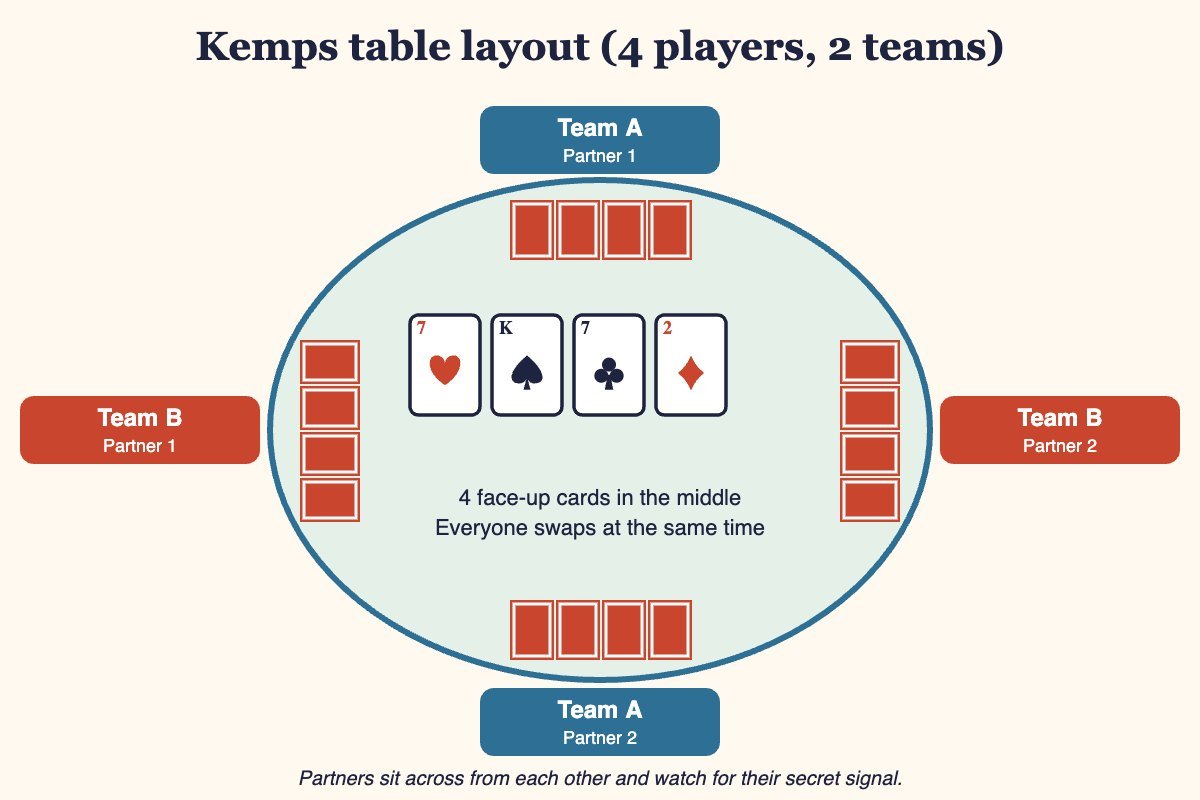
Partners sit across from each other and secretly agree on a signal, like a wink, a cough or touching an ear. Deal four cards to each player and four face up in the middle. On “Go,” everyone swaps cards with the middle at the same time, one card at a time, always holding four. When nobody wants the middle cards, the dealer replaces them with four new ones. When you have four of a kind, give your partner the signal without the other teams noticing. If your partner sees it and calls “Kemps!”, the other teams each get a letter. If an opponent spots your signal, they can call “Cut!” on you: if you really had four of a kind, your team gets a letter; if not, theirs does. A team that spells K-E-M-P-S is out.
9. Nertz
Players: 2–8, more with space | You need: 1 deck per player, each with a different back design
Each player deals a Nertz pile of 13 cards with the top card face up and four face-up work piles. Everyone plays at once. Aces go to the shared center, and anyone can build on any center pile, upward in the same suit. On your own work piles, build down in alternating colors. When someone empties their Nertz pile, they call “Nertz!” and the hand ends. Score one point for every card you played to the center and subtract two for every card left in your Nertz pile. The first to 100 wins.
10. Egyptian Ratscrew
Players: 2–8 | You need: 1 deck, or 2 decks for 6 or more players
Deal all the cards face down. Players flip their top card onto the center pile in turn. When a face card or Ace appears, the next player gets a set number of chances to play a face card too (four for an Ace, three for a King, two for a Queen, one for a Jack); if they fail, the player who played the face card takes the pile. Anyone may slap the pile when two cards of the same rank land in a row (a double) or are separated by one card (a sandwich), and the first hand on the pile wins it. A wrong slap costs one card to the bottom of the pile. In many house rules, players who run out can slap their way back in.
11. Six-Card Golf
Players: 2–8 | You need: 1 deck, or 2 decks for 5 or more players
Each player gets six cards face down in two rows of three and flips any two face up. On your turn, draw from the stock or take the top discard, then swap it for one of your cards or discard it. The round ends when one player has all six cards face up; everyone else gets one last turn. Low score wins. A common scoring system: Ace 1, number cards face value, 2s minus 2, Jacks and Queens 10, Kings 0, and a matching pair in the same column scores 0. Play nine rounds, called holes. Scoring varies a lot between families, so write yours down before the first hole.
Social deduction games with a deck of cards
Pull these out for 10, 15 or 20 people, since each player needs only one card.
12. Wink Murder with playing cards
Players: 8–20 or more | You need: 1 deck
Count out one card per player, making sure the Ace of Spades (the murderer) and a King (the detective) are included. Everyone looks at their card secretly, and the detective announces themselves. Players sit in a circle and chat while the murderer kills people by winking at them. A victim waits a few seconds, then “dies” as dramatically as they like. The detective gets three guesses to name the murderer.
13. Mafia with playing cards
Players: 7–15 plus a moderator | You need: 1 deck
The moderator deals one card to each player: black Aces are the Mafia (use two for 7–10 players and three for 11–15), the King of Hearts is the doctor, the Queen of Hearts is the detective, and number cards are townspeople. At “night,” everyone closes their eyes; the Mafia silently choose a victim, the doctor chooses one person to save and the detective points at someone, and the moderator answers with a thumbs-up or thumbs-down. During the “day,” everyone opens their eyes, the moderator says who was eliminated, and the town debates and votes someone out. The town wins by finding all the Mafia; the Mafia win when they equal the town in number.
Boxed card games for large groups
If you’d like something beyond a standard deck, these well-known boxed games support big groups. Player counts and ages are from the publishers.
14. Uno
Players: 2–10 | Ages: 7+
Match the top card by color or number, use action cards like Skip, Reverse and Draw Two, and call “Uno” when you’re down to one card.
15. Codenames
Players: 2–8+ | Ages: 14+
Two teams race to identify their secret agents from a grid of 25 word cards. Each team’s spymaster gives one-word clues, so any number can join a team.
16. Just One
Players: 3–7 | Ages: 8+
A cooperative word game. Everyone writes a one-word clue to help the guesser find a mystery word, but identical clues are canceled out. Good for mixed ages.
17. The Resistance
Players: 5–10 | Ages: 13+
A hidden-role game where a few spies try to sabotage missions while the rest of the group tries to work out who they are. No one is eliminated.
18. Sushi Go Party!
Players: 2–8 | Ages: 8+
Everyone picks one card from their hand and passes the rest, collecting sushi combinations for points. Turns happen at the same time.
Want a board game for the same crowd? Codenames, Wavelength, Telestrations and The Resistance: Avalon all handle big groups; see our board games for adults guide for player counts and play times.
How to pick the right game for your group
- 6–8 players, mixed ages: Spoons, Pig, Crazy Eights or Sushi Go Party!
- 9–12 players: Cheat or President with two decks, or Kemps if you have an even number.
- 13–20+ players: Chase the Ace, Wink Murder or Mafia with cards.
- Mostly kids: Pig, Spoons, Crazy Eights and Egyptian Ratscrew. Our list of card games for kids has more easy picks by age.
- Adults who want strategy: Oh Hell, President or Nertz.
Tips for hosting card games with a crowd
- Split into tables. With 12 or more people, two tables of six often play better than one giant game. Move winners to the other table after each round.
- Use two matching decks. For games that mix two decks, use decks that look the same so nobody can tell which deck a card came from. For Nertz, you need the opposite: every deck should have a different back.
- Agree on house rules first. President, Golf and Egyptian Ratscrew all have family variations. Settle them before the first deal.
- Clear the table for grabbing games. Spoons and Pig get physical. Move drinks and breakables, and use plastic spoons with younger kids.
- Keep eliminated players busy. In elimination games, let players who are out shuffle, deal or keep score, or keep rounds short so they’re back in soon.
If your group wants a break from cards, try our party games for large groups, which need no equipment at all. Hosting a holiday get-together? These Christmas party games for large groups are built for big crowds, too. You can find more rules guides in our card games section.
FAQ
What is the best card game for a large group?
For a mixed group of 6 to 13 people, Spoons is a reliable first choice because it takes one minute to explain and plays fast. For 14 or more, Chase the Ace works best because each player needs only one card.
What card games can 10 people play with one deck?
With one deck, 10 people can play Spoons, Pig, Chase the Ace, Wink Murder and Mafia with cards. Cheat, President and Crazy Eights also work with 10, but hands get small, so many groups add a second deck.
What card games can you play with 6 players?
Six players is a great size for Oh Hell, Kemps (three teams of two), President, Crazy Eights, Six-Card Golf and Spoons. Most of these need only one deck at six players.
What are good card games for large groups of adults?
Adults tend to enjoy bluffing and strategy: Cheat, President, Oh Hell, Nertz and Mafia with cards. Boxed options like Codenames and The Resistance are also popular with grown-up groups.
What card games can large groups of kids play?
Kids love fast, physical games such as Pig, Spoons, Crazy Eights and Egyptian Ratscrew. Keep rounds short, use plastic spoons and skip elimination so nobody waits too long.
How do you play card games with more than 13 people?
Either choose a game where each player needs one card, like Chase the Ace or Wink Murder, or split the group into smaller tables and rotate players between rounds.
What card games can 15 or 20 people play?
For 15 to 20 people, play a one-card-each game such as Chase the Ace or Wink Murder, which need only one standard deck for the whole room. For longer games, split into two tables of 7 to 10 players and give each table its own game, such as Spoons, Cheat or President, using two decks shuffled together at any table of 9 or more. Nertz also works for big groups if every player has a deck with a different back.
Sources and further reading
- Pig and Spoons rules at Pagat: the classic card-passing games that scale to big groups.
- Card games for six or more players at Pagat: an index of games for bigger tables.
Leave a Reply