
To play Bunco, players take turns rolling three dice and score a point for every die that matches the round number, from 1s in round one up to 6s in round six. Rolling three of the round number is a “Bunco,” worth 21 points. Bunco is usually played by 12 people at three tables of four, in teams of two, and after every round the winners move up a table and everyone gets a new partner.
It is one of the easiest party dice games to learn: there are no decisions to make, so first-timers can join in after one practice roll. This guide covers setup, step-by-step play, scoring, table rotation, how to play Bunco with 8, 4, 2 or any number of players, popular house rules and a short FAQ.
Bunco at a glance
| Detail | Answer |
|---|---|
| Players | 12 is standard (3 tables of 4); any multiple of 4 works, and smaller or odd groups can adapt |
| Teams | Pairs at each table, partners change every round |
| Equipment | 3 dice per table, a bell, score sheets and pencils |
| Rounds | 6 rounds per set (target numbers 1 to 6) |
| Points | 1 per matching die, 5 for a “baby Bunco,” 21 for a Bunco |
| Goal | Win the most rounds (and collect Buncos along the way) |
| Ages | Anyone who can count to 21 can play |
| Skill | None: it is pure luck, which is why it works so well at parties |
Key Bunco terms
- Target number: the number you are trying to roll. It matches the round: 1s in round 1, 2s in round 2 and so on.
- Bunco: all three dice show the target number. Worth 21 points.
- Baby Bunco (mini Bunco): three of a kind of any other number. Worth 5 points.
- Head table: the top table. It rings the bell to start and end each round.
- Set: six rounds, one for each number on the dice.
- Ghost player: an imaginary player used to fill a seat when the group is not a multiple of four.
- Roll-off: a quick tie-breaker in which each player rolls once.
What you need to play Bunco
- 3 dice for each table (9 dice for 12 players)
- A bell, or anything that makes a clear sound, for the head table
- A personal score sheet and pencil for each player
- A tally sheet or scratch paper at each table for team points
- Optional: a fuzzy or “traveling” die for the traveling rule (see variations below)
How to set up Bunco for 12 players
- Set up three tables with four chairs each. Name them the head table, the middle table and the low table. (With more players, add tables in between.)
- Put three dice, a tally sheet and pencils on each table, and the bell on the head table.
- Seat players randomly. A simple way is to mark four score sheets with a star for the head table and hand them out face down.
- At each table, partners sit across from each other, so there are two teams of two.
- Pick one scorekeeper per team at each table to tally points for the round.
How to play Bunco step by step
- The head table rings the bell. Every table starts at the same time, and everyone is rolling for 1s.
- Roll all three dice. Score 1 point for each die showing the target number. If you score at least one point, roll again.
- Keep rolling while you score. Your turn continues as long as each roll earns points. Add every point to your team’s tally.
- Pass the dice when you miss. If a roll scores nothing, your turn ends and the dice go to the player on your left.
- Roll a Bunco for 21 points. Three dice showing the target number is a Bunco. Shout “Bunco!”, take the 21 points for your team and mark a Bunco on your own score sheet.
- The head table ends the round. When a team at the head table reaches 21 points (often by rolling a Bunco), they ring the bell. Players at the other tables stop when they hear it, even if they are past 21.
- Compare scores at each table. The team with more points at its table wins the round. Every player writes a W or an L on their own score sheet.
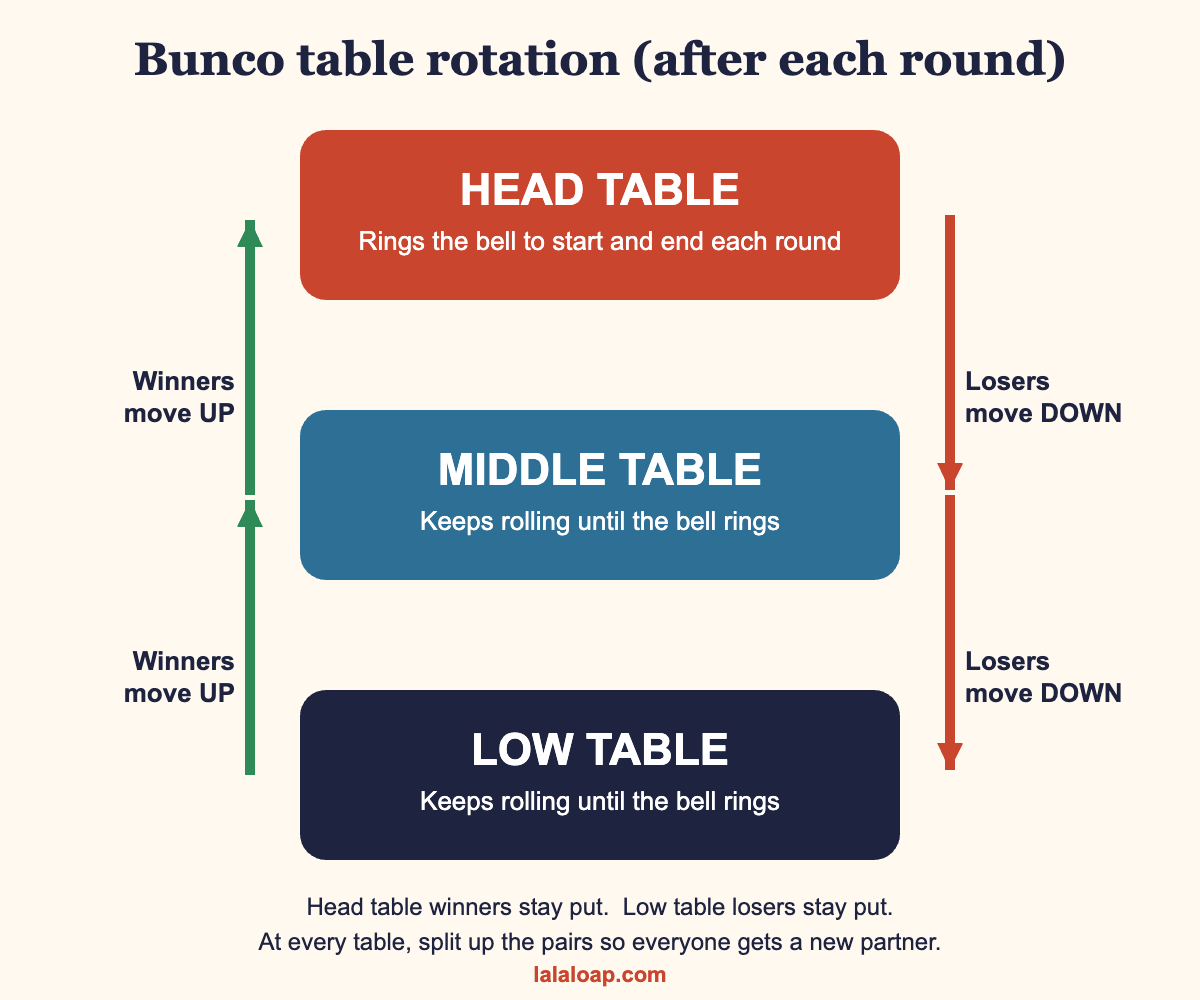
- Rotate and change partners. Winners move up a table and losers move down (see the diagram below). Then start the next round, rolling for the next number.
- Play all six rounds to finish a set. After 6s, start a new set back at 1s. Many groups play several sets in an evening with a snack break in the middle.
How does Bunco scoring work?
Each roll scores on its own, and points from the whole turn add up for your team. These are the standard values:
| Roll (3 dice) | Points | Example in round 3 |
|---|---|---|
| One die matches the target | 1 | 3, 5, 1 |
| Two dice match the target | 2 | 3, 3, 6 |
| Three of a kind, not the target (“baby Bunco”) | 5 | 4, 4, 4 |
| Three of the target number (“Bunco”) | 21 | 3, 3, 3 |
| No target number and no three of a kind | 0, turn ends | 2, 5, 6 |
What are the odds of rolling a Bunco?
On any single roll of three dice, the chance of a Bunco is 1 in 216 (about 0.5%), because each die has a 1-in-6 chance of showing the target number. A baby Bunco is 5 in 216 (about 2.3%). You score at least one point on 96 of the 216 possible rolls (about 44%), so a little over half of all rolls end your turn. These figures come straight from counting the 216 possible results of three dice:
| Outcome on one roll | Chance |
|---|---|
| Bunco (three of the target) | 1 in 216 (0.5%) |
| Baby Bunco (three of another number) | 5 in 216 (2.3%) |
| At least one target die | 91 in 216 (42.1%) |
| Any score at all | 96 in 216 (44.4%) |
| No score, turn ends | 120 in 216 (55.6%) |
How do you rotate tables in Bunco?
After the bell, the winning team at each table moves up one table and the losing team moves down one table. The winners at the head table stay where they are, and so do the losers at the low table. When the new foursomes sit down, split up the pairs so nobody keeps the same partner, which is what makes Bunco such a good mixer.
How do you win Bunco?
Bunco is scored per person, even though you play in pairs. At the end of the night, each player totals their wins, losses and Buncos from their own score sheet. Many groups give prizes in a few categories rather than naming one winner:
- Most wins (often the top prize)
- Most Buncos
- Most losses (a popular consolation prize)
- Last Bunco of the night, or whoever holds the traveling die when play ends
Ties are usually settled with a roll-off: each tied player rolls three dice once, and the highest score wins. Agree on your prize categories before the first round so nobody argues later.
How to play Bunco with different numbers of players
The standard game is built for 12, but the rules stretch easily. The quick rule: add or remove a table for every four players, and use one of the fixes below for anything else.
How to play Bunco with 8 players
Use two tables of four: a head table and a low table. Winners at the low table move up, losers at the head table move down, and partners change every round exactly as in the 12-player game.
How to play Bunco with 16, 20 or more players
Add one table for every four extra players between the head table and the low table. The head table still controls the bell for everyone. Large groups often add a second bell or a clear “stop” call so the far tables hear it.
How to play Bunco with 4 players
With one table, there is nowhere to rotate. Play in two teams of two, switch partners after every round, and keep personal win/loss tallies. The first team to 21 points ends the round.
How to play Bunco with an odd number of players
You have three common options:
- Use a ghost player. The ghost’s partner rolls for the ghost and records its score. The ghost does not win prizes.
- Sit players out in turn. One or two players rest each round and come back in the next, with the rotation agreed in advance.
- Seat three at a table. One person plays solo against a pair and keeps their own score for that round.
Can you play Bunco with 2 players?
Yes. One simple way is a dice race. Take turns rolling three dice for the current target number, scoring as usual. The first player to reach 21 points wins the round, and the player who wins the most of the six rounds wins the game. You lose the table-hopping, but it is a good way to teach the scoring. For another dice game that works well with two, see our Farkle rules.
Bunco variations and house rules
Bunco groups love their own rules. These are the most common ones; pick a few and announce them before the first bell.
- Traveling (fuzzy) die: a special die goes to whoever rolls a Bunco and moves to the next player who rolls one. The person holding it at the end of the night wins a prize.
- Baby Bunco variations: some groups score three of a kind of a non-target number as 5 points, others as 0, and a few end the turn on it.
- Bunco ends the round anywhere: in some groups, a Bunco at any table (not just the head table) means that player shouts and the head table rings the bell.
- Roll on the bell: decide whether a roll already in the air when the bell rings counts. Many groups say no.
- Set count: play a fixed number of sets (often two to four) or play until a set time, so the evening ends on schedule.
Tips for hosting a Bunco night
- Print score sheets ahead of time. Each sheet needs space for W/L marks per round and a Bunco tally.
- Use soft surfaces. A towel or felt mat on each table keeps dice from flying onto the floor and cuts the noise.
- Name a timekeeper at the head table. Their only job is the bell, so rounds start and end cleanly.
- Keep snacks off the rolling area. A side table for food keeps the game moving.
- Explain the rotation once with the diagram. Table moves are the only part of Bunco that confuses new players.
- Plan prizes around categories, not cash. Small treats, gift items or a “winner picks the next host” rule keep it friendly. Bunco has a gambling past, so check local rules before playing for money.
For more ideas for big groups, see our party games for large groups and family game night ideas.
Teaching Bunco to kids
Bunco is a great counting game for children. Kids practice recognizing dot patterns, adding small numbers and counting up to 21. For younger players:
- Play at one table with family members and skip table rotation at first.
- Lower the round target to 11 points so rounds are quicker.
- Let a grown-up keep the tally sheet while kids call out their points.
- Use large dice, and keep dice away from children under 3 because they are a choking hazard.
Bunco pairs well with the games in our list of dice games for kids, and you can find more rolling games on our dice games page.
A short history of Bunco
Bunco began as a swindle: the word itself still means “a swindling game or scheme” in American English. According to Wikipedia, the game descends from an English dice game called “eight dice cloth” and came to San Francisco as a gambling game in 1855, where “bunco parlors” gave their name to con games in general. Police units that raided gambling parlors in the 1920s became known as “bunco squads.” The game also became a popular parlor game, and it saw a big revival as a social game in the 1980s.
Want a dice game with more decisions per turn? Try our guide to how to play Yahtzee, which works for 2 to 6 players around one table.
Bunco FAQ
How many players do you need for Bunco?
The standard game uses 12 players at three tables of four. Any multiple of four works by adding or removing tables, and you can play with as few as 2 or 4, or with an odd number using a ghost player.
How long does a game of Bunco take?
It depends on how many sets you play. Each set has six rounds, and each round lasts only as long as it takes the head table to reach 21 points, so most groups set the length by choosing two to four sets or by playing until a fixed time.
What is a baby Bunco?
A baby Bunco, or mini Bunco, is three of a kind of any number other than the round’s target number. It is usually worth 5 points, though some groups score it differently.
What happens if there is a tie in Bunco?
If two teams at a table have the same score when the bell rings, each player rolls the three dice once and the team with the higher combined roll wins the round. Prize ties are usually broken the same way.
Does a Bunco at another table end the round?
In standard rules, no. Only the head table ends the round, usually by reaching 21 points. Players at the other tables keep rolling until they hear the bell. Some groups change this as a house rule.
Is Bunco a gambling game?
It started as one, but today Bunco is mostly played as a social game with small prizes. If your group wants to put money into a prize pot, check your local laws first.
Sources and further reading
- Bunco (Wikipedia): history, standard rules and scoring.
- Bunco (Merriam-Webster): definition of the word bunco.
Leave a Reply