
Here is how to play Farkle: roll six dice, set aside at least one scoring die (1s, 5s or a scoring combination), then either bank your points or roll the rest of the dice to try for more. If a roll has no scoring dice, that is a “Farkle” and you lose every point from that turn. The first player to reach 10,000 points triggers a final round, and the highest score after that round wins.
That push-your-luck choice is what makes Farkle such a good family dice game. It takes a minute to learn, works for two players or a whole table, and needs nothing more than six dice and a pencil. This guide covers the full Farkle rules, a scoring chart, the odds of farkling, popular house rules and tips for teaching kids.
Farkle at a glance
| What | Details |
|---|---|
| Players | 2 or more (best with 3 to 6) |
| Ages | About 8 and up; younger kids can play on a team |
| You need | 6 standard dice, paper and a pencil, a cup to roll from (optional) |
| Game length | About 30 to 60 minutes to 10,000 points |
| Goal | Be the player with the most points after someone reaches 10,000 |
| Also called | Ten Thousand, 10,000, Zilch, Greed, Hot Dice, Zonk |
Key Farkle terms
- Farkle: a roll with no scoring dice. Your turn ends and you score zero for that turn.
- Set aside: moving scoring dice out of play so you can roll the rest.
- Bank: stopping your turn and writing your points on the score sheet. Banked points are safe.
- Hot dice: when all six dice have been set aside as scoring dice. You may pick up all six and keep rolling.
- Opening score: a minimum turn total (often 500) some families require before a player can bank for the first time.
How to set up Farkle
- Find six standard six-sided dice and a flat surface. A cup or box lid keeps the dice from flying off the table.
- Make a score sheet with one column per player.
- Agree on the house rules before you start: the target score (10,000 is standard), whether there is an opening score, and the scoring values you will use (see the chart below).
- Each player rolls one die. The highest roll goes first, and play passes to the left.
How to play Farkle step by step
A Farkle turn is a series of rolls. After each roll you decide whether to stop and bank or risk your points on another roll.
- Roll all six dice at the start of your turn.
- Look for scoring dice. Single 1s and 5s score, and so do three of a kind and the six-dice combinations in the chart below.
- If nothing scores, you farkle. Say “Farkle!”, score zero for the turn and pass the dice.
- Set aside at least one scoring die. You must take at least one, but you do not have to take them all. Leaving a 5 on the table gives you one more die to roll.
- Add up your running total for the turn.
- Choose: bank or roll. Bank to write the running total on the score sheet and end your turn, or roll only the dice you did not set aside.
- Repeat steps 2 to 6. Each new roll must produce at least one scoring die, or you farkle and lose the whole turn’s total.
- Hot dice: if you have set aside all six dice, you may roll all six again and keep adding to the same turn total.
Example turn
You roll 1, 3, 3, 3, 4, 6. You set aside the three 3s (300) and the 1 (100) for 400 and have two dice left. You could bank 400, but you roll the two dice and get a 5 and a 2. You set aside the 5 (50) for a running total of 450. With one die left, the chance of farkling is two in three, so you bank 450.
Farkle scoring chart
Farkle has no single official rulebook, so scoring varies from family to family. The values below are the ones most widely used for six-dice Farkle. The right-hand column shows common alternatives you may see on boxed rule sheets and score cards.
| Dice | Points | Common alternatives |
|---|---|---|
| Each 1 | 100 | — |
| Each 5 | 50 | — |
| Three 1s | 1,000 | 300 (Pocket Farkel boxed game) |
| Three 2s | 200 | — |
| Three 3s | 300 | — |
| Three 4s | 400 | — |
| Three 5s | 500 | — |
| Three 6s | 600 | — |
| Four of a kind | 1,000 | Double the three-of-a-kind score |
| Five of a kind | 2,000 | Double again |
| Six of a kind | 3,000 | Double again, or an instant win |
| Straight (1-2-3-4-5-6) | 2,500 | 1,000, 1,500 or 3,000 |
| Three pairs | 1,500 | 750 or 2,000 |
| Four of a kind plus a pair | 1,500 | Counted as three pairs |
| Two triplets | 2,500 | 3,000 |
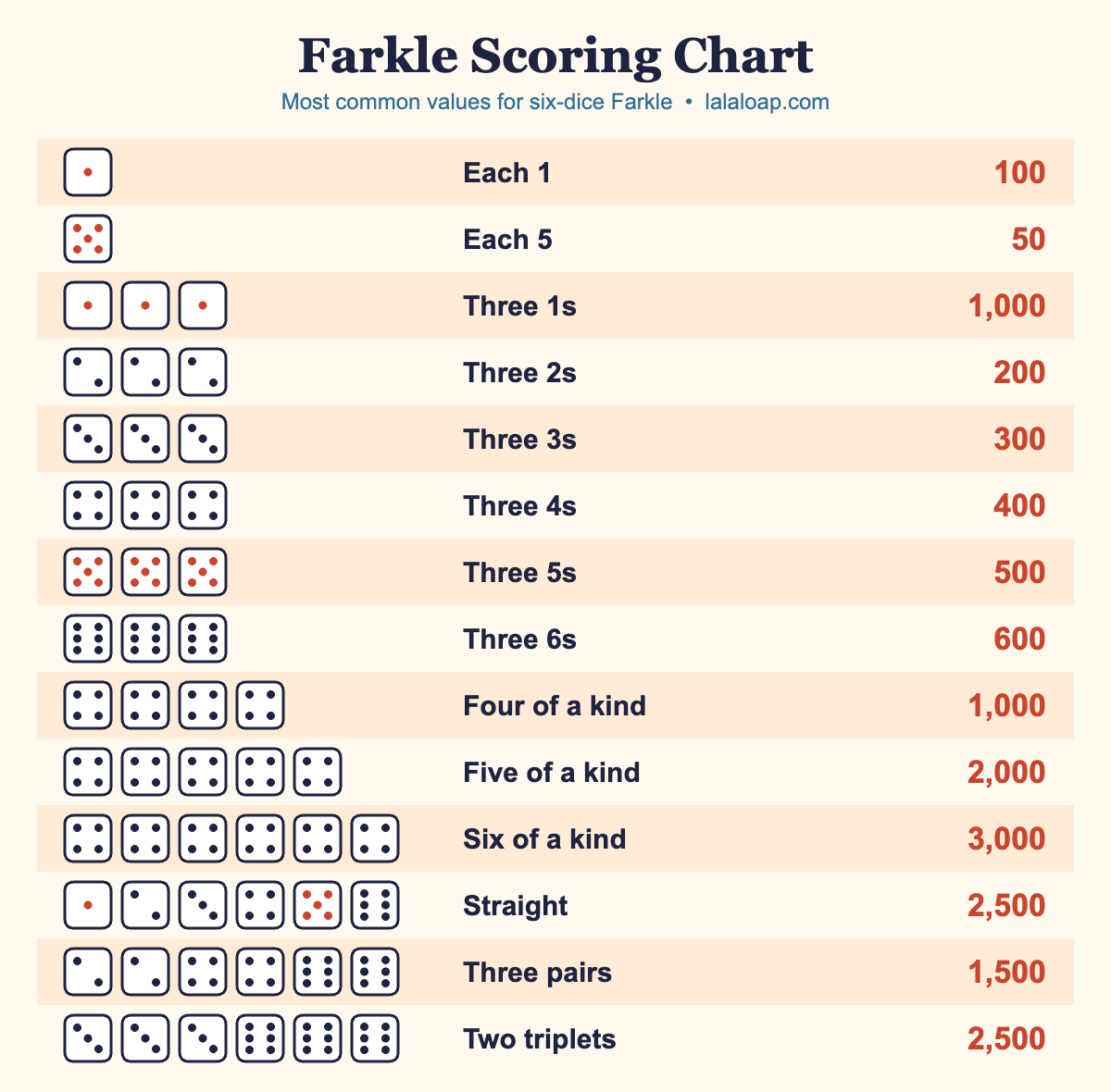
Pick one value for each row before the game starts and write it at the top of the score sheet, so nobody argues about a straight or three pairs halfway through the game.
Farkle scoring rules that trip people up
- Combinations only count within one throw. If you set aside two 4s and roll a third 4 later, you do not have three of a kind. The extra 4 scores nothing on its own.
- Only 1s and 5s score as single dice. A lone 2, 3, 4 or 6 is worth nothing.
- Six-dice combinations need all six dice in one roll. A straight, three pairs or two triplets can only happen on a roll of all six dice.
- Extra dice in a combination still count. Rolling 5, 5, 5, 5 gives you four of a kind, not three 5s plus a single 5, unless your family scores it that way.
What is the opening score in Farkle?
The opening score (also called getting on the board) is a house rule that says a player must bank at least a certain number of points in one turn before any of their points count. Most families who use it set it at 500. Some use 350 or 1,000. Once you have banked your opening score, you can stop on any later turn whenever you like.
A stricter variation requires a minimum every turn, often 300 or 350. It makes the game faster for experienced players but harder for beginners, so skip it when kids are playing.
How do you win Farkle?
The game ends when a player banks a total of 10,000 points or more. Every other player then gets one final turn to beat that score. After the final round, the highest total wins. If you are still behind on your final turn, there is no reason to bank early: keep rolling until you pass the leader or farkle.
Some families play to 5,000 for a shorter game or 1,000 for very young players. Others skip the final round and let the first player to 10,000 win outright. Agree on this before you start.
What are the odds of farkling?
The fewer dice you roll, the more likely you are to farkle. These percentages are the exact odds of rolling no scoring dice with the standard combinations above:
| Dice rolled | Chance of a Farkle | Chance of scoring |
|---|---|---|
| 6 | 2.3% | 97.7% |
| 5 | 7.7% | 92.3% |
| 4 | 15.7% | 84.3% |
| 3 | 27.8% | 72.2% |
| 2 | 44.4% | 55.6% |
| 1 | 66.7% | 33.3% |
With one or two dice left, you are close to a coin flip or worse, so banking is usually smart unless your turn total is small. With three or more dice, rolling again is usually worth the risk until you have a few hundred points.
Farkle by player count
How to play Farkle with 2 players
The rules do not change for two players. Take turns rolling, and when one player reaches 10,000, the other gets one final turn. Two-player games move quickly, so some pairs play to 5,000 and play best of three. If you want more two-player ideas, our guide to card games for 2 people has plenty.
Farkle for a big group
Farkle works with any number of players because only one person rolls at a time. With more than six players, waiting gets long, so try a lower target (5,000), play in teams of two that share one score, or set up two tables. For other ideas that keep a crowd busy, see our card games for large groups.
How to play Farkle with 5 dice
Five-dice Farkle uses the same rules, but three pairs, two triplets and six of a kind are impossible. Some families score a five-dice straight (1-2-3-4-5 or 2-3-4-5-6) at 500. With fewer dice, farkles come more often, so many groups lower the target to 5,000.
Popular Farkle variations and house rules
- Three farkles in a row: lose 500 or 1,000 points from your banked total. This stops players from rolling recklessly every turn.
- Doubling for big sets: four of a kind is double the three-of-a-kind score, five of a kind is double that, and so on. Three 1s worth 1,000 become 2,000, 4,000 and 8,000.
- Pocket Farkel scoring: the commercial game sold as Pocket Farkel scores three 1s at 300 instead of 1,000.
- Six-dice Farkle bonus: if your very first roll of six dice scores nothing, some families give you 500 points instead of a Farkle.
- Exactly 10,000 (welfare Farkle): the winner must hit 10,000 exactly. If you go over, that turn’s points go to the player with the lowest score instead.
Farkle strategy tips
- Leave single 5s behind. If you roll a 1 and a 5, setting aside only the 1 gives you five dice for the next roll instead of four.
- Bank with one or two dice left unless your turn total is under about 300.
- Chase hot dice carefully. Rolling the last die to get all six back is tempting, but you only score on a 1 or 5.
- Watch the scoreboard. Take more risks when you are far behind and fewer when you are leading near the end.
- Use the final turn fully. On your last turn, bank only once you have passed the leader.
Teaching Farkle to kids
Farkle is a natural math game: kids add numbers in the hundreds and thousands and quickly see why risk matters. To make the first games easier:
- Print or copy the scoring chart and keep it on the table.
- Use the simplest scoring: 1s, 5s and three of a kind only. Add the six-dice combinations once kids are comfortable.
- Play to 2,000 or 5,000 and skip the opening score.
- Let a younger child team up with an older player who keeps the score sheet.
- Use larger dice; six small dice are a choking hazard for toddlers.
For more games that use regular dice, see our list of dice games for kids, or add Farkle to your next family game night.
Farkle vs. Yahtzee: what’s the difference?
Both games use dice and rerolls, but they play differently. Yahtzee uses five dice, gives each player three rolls per turn and fills in a 13-box score card. Farkle uses six dice, lets you roll as many times as you dare, and wipes out your turn when you roll no scoring dice. Farkle is also free to play with any six dice, while Yahtzee normally uses its own score cards.
Looking for a dice game that needs no strategy at all? Bunco is a pure-luck team game for 4 to 12 or more players. Here is how to play Bunco, including scoring and table rotation.
For the full scoring card, upper bonus and bonus Yahtzee rules, see our step-by-step guide on how to play Yahtzee.
Farkle FAQ
How many dice do you need for Farkle?
You need six standard six-sided dice. A five-dice version exists too, but six is the most common.
What is three pairs worth in Farkle?
Three pairs (for example 2-2, 4-4, 6-6) are usually worth 1,500 points. Some families score them at 750 or 2,000. Many families also count four of a kind plus a pair as three pairs.
How much is four of a kind in Farkle?
In the most common scoring, four of a kind is worth 1,000 points. Families that use doubling score it at twice the three-of-a-kind value, so four 4s would be 800.
Can you farkle on your first roll?
Yes. If your first roll of six dice has no 1s, no 5s and no scoring combinations, you farkle and score zero. It happens on only about 2.3% of six-dice rolls.
Do you have to take all the scoring dice?
No. You must set aside at least one scoring die after each roll, but you can leave others to roll again. Many players leave 5s behind to keep more dice in play.
How many points do you need to start in Farkle?
There is no starting minimum in the basic rules. Many families add an opening score of 500, which you must bank in a single turn before any of your points count.
Find more games you can play with dice in our dice games section.
Sources and further reading
- Farkle on Wikipedia: history, other names and the main scoring variants.
Leave a Reply