

The best dice games for kids are short, quick to explain and need nothing but a few regular six-sided dice: Pig, Beetle, Fifty, Going to Boston and Ship, Captain and Crew are classic examples. Below are 18 easy dice games for kids, sorted by age, with the number of dice you need, how many can play and simple step-by-step rules.
All you need is ordinary dice and a pencil for scores. Most games take 5 to 20 minutes, so they fit easily into a family game night or a rainy afternoon.
Dice games for kids at a glance
| Game | Ages | Players | Dice |
|---|---|---|---|
| Roll and Cover | 3+ | 1–4 | 1–2 |
| Dice War | 4+ | 2 | 2 |
| Beetle | 4+ | 2–6 | 1 |
| Race to 20 | 4+ | 2–6 | 1 |
| Big Number | 5+ | 2–6 | 3 |
| Fifty | 5+ | 2+ | 2 |
| Going to Boston | 6+ | 2–8 | 3 |
| Chicago | 6+ | 2+ | 2 |
| Pig | 6+ | 2+ | 1 |
| Knock Out | 6+ | 2–4 | 2 |
| Shut the Box (paper) | 6+ | 1+ | 2 |
| Three or More | 7+ | 2+ | 5 |
| Ship, Captain and Crew | 7+ | 2+ | 5 |
| Bunco | 7+ | 4–12 | 3 |
| Left Right Center | 6+ | 3+ | 3 |
| Multiplication Roll | 8+ | 2+ | 2 |
| Farkle | 9+ | 2+ | 6 |
| Yacht | 9+ | 1+ | 5 |
Ages are a guide, not a rule.
What you need
- Dice: regular six-sided dice. Five or six is plenty for every game on this list. Bunco needs three dice per table.
- Paper and pencils for scores.
- A cup, tray or shallow box to roll into. It keeps dice on the table and the game moving.
- Counters such as coins, buttons or dried beans for Left Right Center and Roll and Cover.
Small dice are a choking hazard, so keep them away from children under 3 and supervise younger players.
Very easy dice games for ages 3 to 5
These games use one or two dice and teach kids to recognize the dot patterns on a die (a skill called subitizing) and to count.
1. Roll and Cover
Players: 1–4 · Dice: 1 or 2
- Draw a row of numbers 1 to 6 on paper for each player (use 2 to 12 if you play with two dice).
- On your turn, roll and cover that number with a counter.
- If it is already covered, your turn passes.
- The first player to cover every number wins.
For a cooperative version, share one sheet and count how many rolls the family needs.
2. Dice War
Players: 2 · Dice: 2 each
Each player rolls two dice at the same time and adds them up. The higher total wins a point; ties are rolled again. The first to 10 points wins. Toddlers can play with one die each and simply compare dots, and older kids can switch to subtraction (bigger minus smaller) or multiplication.
3. Beetle
Players: 2–6 · Dice: 1
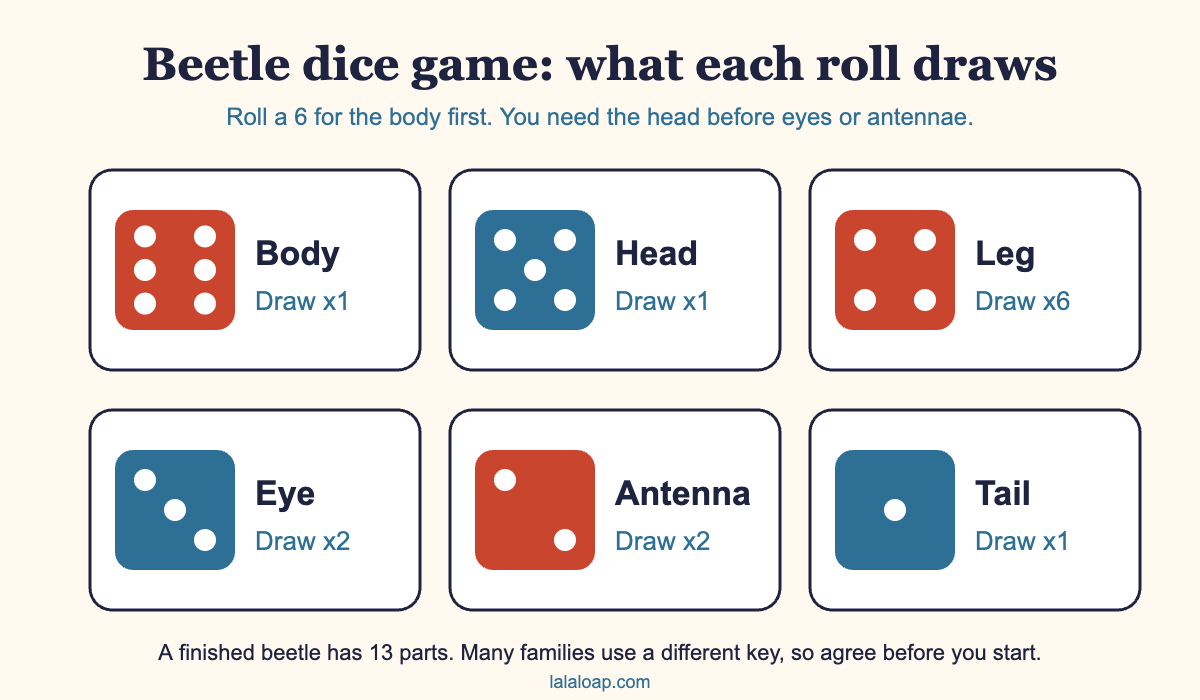
Beetle (also called Bugs or Cootie in some families) is a drawing race. Each number on the die stands for a body part:
| Roll | Part |
|---|---|
| 6 | Body |
| 5 | Head |
| 4 | Leg |
| 3 | Eye |
| 2 | Antenna |
| 1 | Tail |
- Take turns rolling one die.
- You must roll a 6 for the body before you can add anything else.
- You need the head (5) before you can draw eyes or antennae.
- If you roll a part you cannot use yet, or one you already finished, pass the die.
- The first player to draw a complete beetle (13 parts) shouts “Beetle!” and wins.
The number assigned to each part varies from family to family, so agree on the key before you start.
4. Race to 20
Players: 2–6 · Dice: 1
Write the numbers 1 to 20 in a path (or use any board game track). Each player rolls and moves that many spaces, counting out loud. The first to reach 20 wins. To practice counting backward, start at 20 and race down to 0, which needs an exact roll to finish.
Easy dice games for ages 5 to 7
These add simple choices and bigger numbers, so they work well for kindergarten and early elementary kids.
5. Big Number
Players: 2–6 · Dice: 3
Each player rolls three dice and arranges them to make the biggest three-digit number possible. Rolling 2, 6 and 4 makes 642. The biggest number wins the round. Try “smallest wins” or “closest to 500 wins” for variety. It is an easy way to teach place value.
6. Fifty
Players: 2 or more · Dice: 2
Only doubles count in Fifty, which makes it simple to follow.
- Take turns rolling two dice.
- Any double scores 5 points, except double 6, which scores 25.
- Double 3 wipes out your whole score and you go back to zero.
- Any roll that is not a double scores nothing, and the dice pass on.
- The first player to reach 50 points wins.
7. Going to Boston
Players: 2–8 · Dice: 3
- Roll all three dice and set aside the highest one.
- Roll the other two and set aside the higher one.
- Roll the last die.
- Add the three set-aside dice. That total is your score for the round.
- The highest score wins the round. Play to an agreed number of round wins, or keep a running total to 100.
It is also called Yankee Grab and is a great first game for adding three numbers.
8. Chicago
Players: 2 or more · Dice: 2
Chicago has 11 rounds, one for each possible total from 2 to 12.
- In round 1 the target is 2, in round 2 the target is 3, and so on up to 12.
- Each player rolls two dice once per round.
- If your total matches the round’s target, you score that many points.
- After the round for 12, the highest total score wins.
Kids soon notice that 7 comes up far more often than 2 or 12.
9. Knock Out
Players: 2–4 · Dice: 2
- Each player picks a different “knock out” number: 6, 7, 8 or 9.
- Take turns rolling two dice and adding them.
- If you roll your own knock out number, you are out of the game.
- Any other total is added to your score.
- The first player to 100 points wins, or the last player still in.
Whoever picks 7 learns fast that it is the most common two-dice total.
10. Shut the Box (paper version)
Players: 1 or more · Dice: 2
- Write the numbers 1 to 9 in a row.
- Roll two dice and add them.
- Cross off any numbers that add up to your total. A roll of 8 could cross off 8, or 5 and 3, or 6 and 2, or 1, 3 and 4.
- Keep rolling until you cannot cross off numbers that match your roll.
- Add up the numbers left. Lowest score wins, and crossing off everything (“shutting the box”) is an instant win.
A common house rule lets you roll one die once 7, 8 and 9 are gone.
Dice games for ages 7 and up
These classics suit kids who can add bigger numbers and remember a few rules, and adults enjoy them too.
11. Pig
Players: 2 or more · Dice: 1
Pig is the classic push-your-luck dice game.
- On your turn, roll one die as many times as you want, adding each roll to your turn total.
- If you roll a 1, you lose all the points from that turn and the die passes.
- If you stop before rolling a 1, add your turn total to your score.
- The first player to reach 100 wins.
For young kids, play to 50. A popular variation, Two-Dice Pig, uses two dice: a single 1 ends your turn with no points, and double 1s wipe out your whole score.
12. Three or More
Players: 2 or more · Dice: 5
- Roll all five dice. You score only for three or more of a kind.
- Three of a kind scores 3 points, four of a kind scores 6 and five of a kind scores 12.
- If you roll only a pair, you may reroll the other three dice once to try for more.
- The first player to reach 50 points wins.
13. Ship, Captain and Crew
Players: 2 or more · Dice: 5
- You get up to three rolls on your turn.
- You need a 6 (the ship), then a 5 (the captain), then a 4 (the crew), in that order. Set each aside as you get it.
- Once you have all three, the other two dice are your “cargo.” Their total is your score.
- If you still have rolls left, you may reroll the cargo to try for a higher total.
- If you do not get a ship, captain and crew in three rolls, you score zero. Highest score wins the round.
14. Bunco
Players: 4–12 (in teams of two) · Dice: 3 per table
- Play six rounds. The round number is the target: in round 1 you want 1s, in round 2 you want 2s, and so on.
- Roll three dice. Score 1 point for each die that matches the target, and keep rolling while you score.
- Rolling three of the target number is a “Bunco” and scores 21 points.
- Three of a kind that is not the target scores 5 points.
- When a roll scores nothing, pass the dice. The first team at the head table to reach 21 points ends the round.
Full Bunco has players switching tables and partners between rounds; with kids, one table is fine.
15. Left Right Center
Players: 3 or more · Dice: 3
Left Right Center (LCR) is usually sold with special dice, but you can play with regular dice and a simple key.
- Each player starts with 3 counters, such as coins or buttons.
- On your turn, roll one die for each counter you have, up to three dice.
- For each 1, pass a counter to the player on your left. For each 2, put one in the center pot. For each 3, pass one to the right. A 4, 5 or 6 means you keep it.
- Players with no counters skip their roll but stay in, because they can still receive counters.
- The last player with any counters wins the center pot.
LCR involves no choices, so grandparents and preschoolers can play at the same table.
16. Multiplication Roll
Players: 2 or more · Dice: 2
Each player rolls two dice and multiplies them. The higher product wins the round, and the first to 10 round wins takes the game. It is good times-tables practice for second and third graders.
17. Farkle
Players: 2 or more · Dice: 6
Farkle suits older kids who are comfortable with big numbers. In common rules, each 1 is worth 100 points, each 5 is worth 50, and three of a kind is worth 100 times the number shown, except three 1s, which are worth 1,000. On your turn you roll, set aside at least one scoring die, then choose to bank your points or roll the rest. A roll with no scoring dice is a “farkle” and loses everything from that turn. The first player to 10,000 wins. Scoring varies a lot between families, so write your rules down before you begin.
18. Yacht
Players: 1 or more · Dice: 5
Yacht is the old public-domain game that inspired Yahtzee. Each turn you get up to three rolls of five dice, keeping any dice you like between rolls, and then score the result in one of 12 boxes: ones through sixes, full house, four of a kind, little straight, big straight, choice and yacht (five of a kind). Each box is used once, so kids must plan ahead.
How to choose a dice game by age
- Ages 3–4: Roll and Cover, Dice War with one die, Beetle with help.
- Ages 5–6: Fifty, Race to 20, Big Number, Going to Boston, Chicago.
- Ages 7–8: Pig, Knock Out, Shut the Box, Three or More, Ship, Captain and Crew, LCR.
- Ages 9 and up: Farkle, Yacht, Bunco with table switching, and any game above played to a higher target.
Dice games for 2 players, groups and travel
Best for two players: Dice War, Pig, Shut the Box, Yacht and Multiplication Roll. If you want more ideas for a pair, our list of card games for 2 people has plenty.
Best for big groups: Bunco, Left Right Center, Going to Boston and Fifty, since turns are quick and anyone can join between rounds.
Best for travel: Pig, Fifty and Ship, Captain and Crew need almost nothing. Roll inside a small plastic container with a lid so the dice cannot escape. For screen-free ideas that need no dice at all, see our road trip games for kids.
How dice games help kids learn
Dice games build math skills without worksheets. Young kids learn to recognize dot patterns and count on. Older kids add several numbers in their heads, multiply and get an early feel for probability: 7 is the most common two-dice total because it can be made six ways. They also practice taking turns and losing gracefully.
Tips for playing dice games with kids
- Teach one game at a time. Play a practice round where nobody keeps score.
- Lower the target. Play Pig to 50 or Fifty to 30 for short attention spans.
- Let kids keep score. Writing and adding the totals is half the math practice.
- Agree on house rules first. Many classic dice games have local variations, so settle the rules before the first roll.
- Mix in other games. Pair dice games with card games for kids or games you can play at home without anything for a full game night.
Find more rules and ideas in our dice games and kids’ games sections.
Want a dice game for a bigger crowd? Bunco works for 12 or more players at three tables, and anyone who can count to 21 can join in. See our guide on how to play Bunco.
Ready for a longer game with older kids? Our guide to how to play Yahtzee explains every scoring box, the upper bonus and the Joker rule.
Frequently asked questions
What are easy dice games for kids with 2 dice?
Dice War, Fifty, Chicago, Knock Out, Shut the Box and Multiplication Roll all use two regular dice. Fifty is the simplest, because only doubles score.
What dice games are good for 5-year-olds?
Roll and Cover, Beetle, Race to 20, Dice War and Fifty work well for most 5-year-olds. They use one or two dice and need only counting or simple matching.
What dice games can you play with 5 dice?
Yacht, Three or More, and Ship, Captain and Crew all use five dice. Farkle normally uses six, but many families play it with five.
How many dice do you need for dice games?
Most kids’ dice games need one to three dice. A set of six regular dice covers every game on this list except full Bunco, which uses three dice for each table.
What are good math dice games for kindergarten?
Roll and Cover, Dice War, Race to 20 and Big Number are great for kindergarten. They build counting, number recognition, adding and place value.
Can kids play dice games alone?
Yes. Shut the Box, Yacht and a cooperative version of Roll and Cover all work as solo games. Kids can try to beat their own best score.
Sources and further reading
- Shut the Box on Wikipedia: history and common rule variants.
- Choking prevention from HealthyChildren.org: American Academy of Pediatrics advice on small items like dice for young children.
Leave a Reply