
Kings in the Corner feels like a game of solitaire that everyone plays together. Players build descending piles in alternating colors around a cross-shaped layout, kings get their own corner spots, and the first person to empty their hand wins. It is calm enough for a 6-year-old who can count backward and tell red from black, yet it has enough choices to keep adults interested.
Some guides online describe a one-player grid game under the same name. The family version below, with a shared cross layout, is the one most people mean.
Kings in the Corner at a glance
| What | Details |
|---|---|
| Players | 2 to 4 (four is the sweet spot) |
| Ages | About 6 and up |
| You need | One standard 52-card deck, jokers removed |
| Time | 10 to 20 minutes per round |
| Goal | Be the first to play every card from your hand |
Key terms
- Draw pile: the stack of face-down cards in the middle of the table.
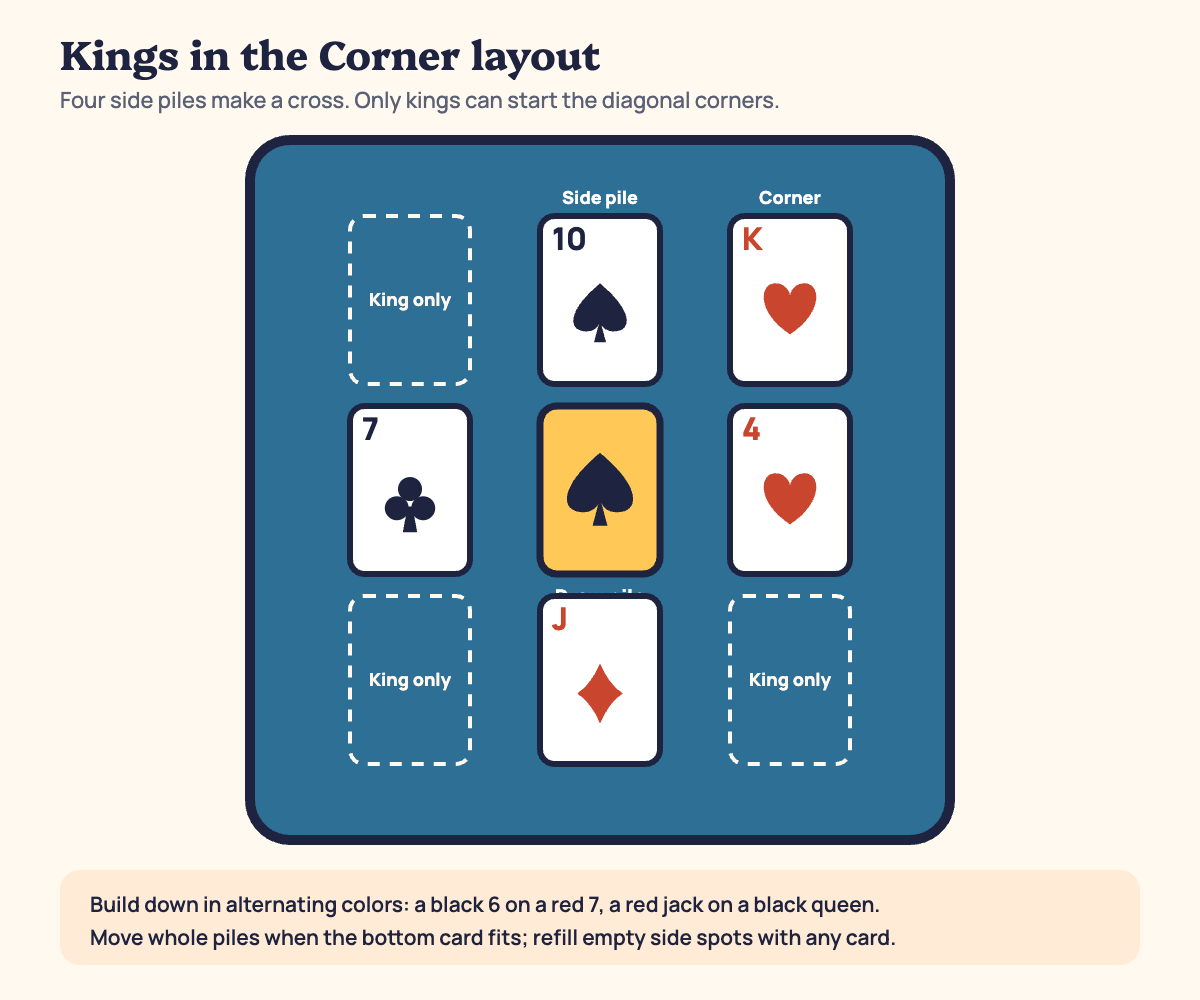
- Side piles: the four face-up piles above, below, left and right of the draw pile, forming a cross.
- Corner piles: the four empty diagonal spots between the side piles. Only kings can start these.
- Building down: placing the next lower card of the opposite color on a pile, such as a red 9 on a black 10.
How to set up Kings in the Corner
- Shuffle and deal seven cards to each player, one at a time.
- Put the rest of the deck face down in the middle of the table. This is the draw pile.
- Turn four cards face up from the draw pile and place one on each side of it (top, bottom, left and right) to make a cross. These are the side piles.
- Leave the four diagonal corners empty. They are reserved for kings.
- If a king turns up while you set out the side piles, move it into a corner and deal a new card to replace it.
How a turn works
The player to the dealer’s left goes first, and play moves clockwise.
- Draw one card from the draw pile at the start of your turn.
- Make as many legal plays as you like, in any order:
- Build down in alternating colors on any side or corner pile: a black 6 on a red 7, a red jack on a black queen.
- Play a king to an empty corner. Once it is there, anyone can build down on it.
- Move a whole pile. If the bottom card of a side pile could legally go on top of another pile, move the entire pile there. For example, a side pile starting with a black 8 can move onto a pile ending in a red 9.
- Fill an empty side space. Moving a pile leaves a gap. You can put any card from your hand into an empty side space to start a new pile.
- End your turn when you cannot or do not want to make any more plays. Play passes to the left.
Aces are low, so an ace finishes a pile: nothing can be played on top of it.
How to win Kings in the Corner
The first player to play every card from their hand wins the round.
If the draw pile runs out, keep playing without drawing. If nobody can make a move, the round ends and the player holding the fewest cards wins. Some families let the leftover side piles be reshuffled into a new draw pile instead; agree before you start.
Optional scoring
For a longer game, score each round:
- Players who did not go out take 1 penalty point for each card left in their hand.
- Each king left in hand counts 10 points, which is why it pays to get kings onto the table early.
- Pick a target, such as 25 or 50 points. When any player reaches it, the player with the lowest total wins.
Strategy tips
- Play kings as soon as you can. They are useless in your hand and expensive if you get caught holding one.
- Create empty side spaces on purpose. Moving a pile opens a slot where you can dump an awkward card, like a stray 3 that fits nowhere else.
- Think about the next player. If you can choose between two plays, avoid opening a spot that sets up an easy move for the person after you.
- Count what is left. Late in the round, notice which colors and ranks are already on the table so you know whether a pile can still be extended.
Variations
- Mandatory kings: if you hold a king and a corner is open, you must play it on your turn.
- Draw at the end: some families draw at the end of a turn instead of the start. It slows the game slightly and is easier for beginners.
- Two-deck Kings Corner: for 5 or 6 players, shuffle two decks together and deal seven each. There will be eight kings, so corner piles fill and get extended faster.
- Pay the pot: each player puts a token (chips, candies, pennies) in the middle at the start, adds one whenever they end a turn without playing a card, and the winner takes the pot.
Teaching Kings in the Corner to kids
Lay the cross out with lots of space between piles and let younger kids play with their hand face up while they learn. Say the rule out loud as they play: “one lower, other color”. It doubles as counting practice and color matching, and a round is short enough to keep attention.
Kings in the Corner FAQ
How many cards do you deal in Kings in the Corner?
Seven cards each, whatever the number of players.
Can you put a card other than a king in a corner?
No. Corners can only be started with a king. Empty side spaces, though, can take any card.
Can two people play Kings in the Corner?
Yes. The rules are the same, and it makes a good two-player game.
Can you move a pile onto a king in a corner?
Yes, as long as the bottom card of the pile fits: a red queen-led pile can move onto a black king, for example.
Do you have to draw a card if you can play?
Yes. In the standard rules you always draw one card at the start of your turn, then play.
What happens with aces?
Aces are the lowest card. When an ace lands on a pile, nothing more can be added to it.
Want a louder game for bigger groups? Try Spoons, or browse our family game night ideas.
Leave a Reply