
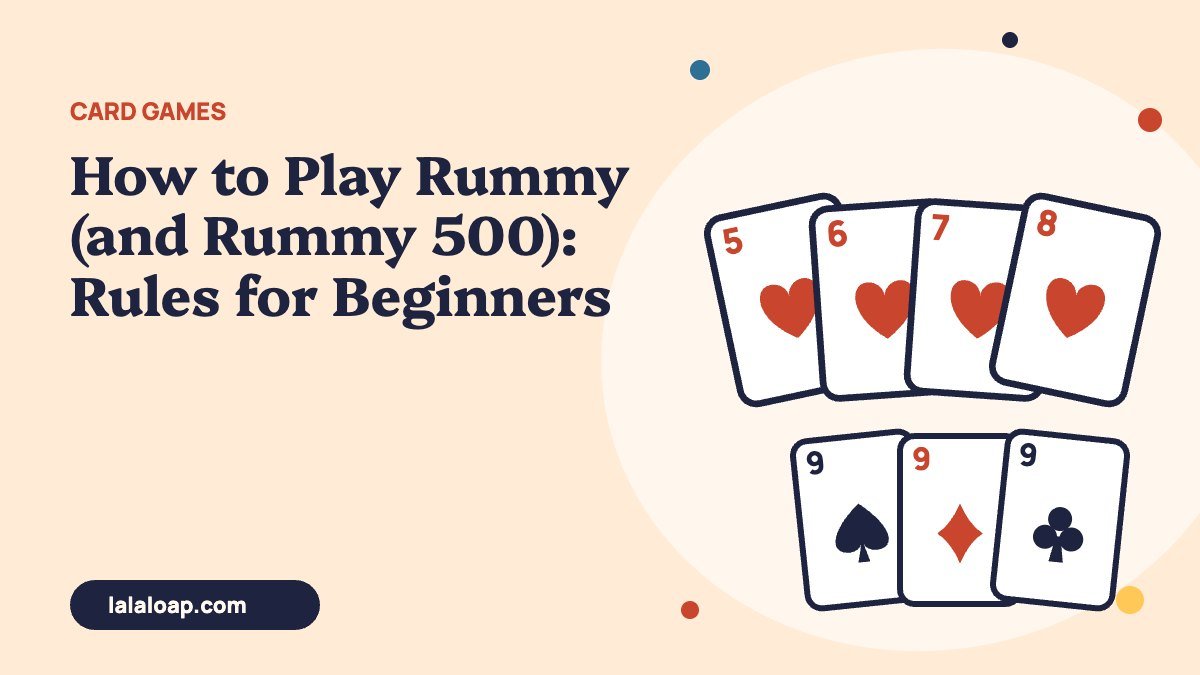
Rummy is the card game most families learn first and keep playing for life. You draw, you discard, and you try to group your cards into sets and runs before anyone else. The basic rules take five minutes to learn, and once you know them you can play Gin Rummy, Rummy 500 and dozens of other versions. This guide covers standard Rummy step by step, then Rummy 500 and tips for 2 players.
Rummy at a glance
| What | Details |
|---|---|
| Players | 2 to 6 |
| Ages | About 8 and up |
| You need | One standard 52-card deck, pen and paper for scoring |
| Time | 10 to 15 minutes per hand |
| Goal | Be first to get rid of your cards by forming melds |
Key terms
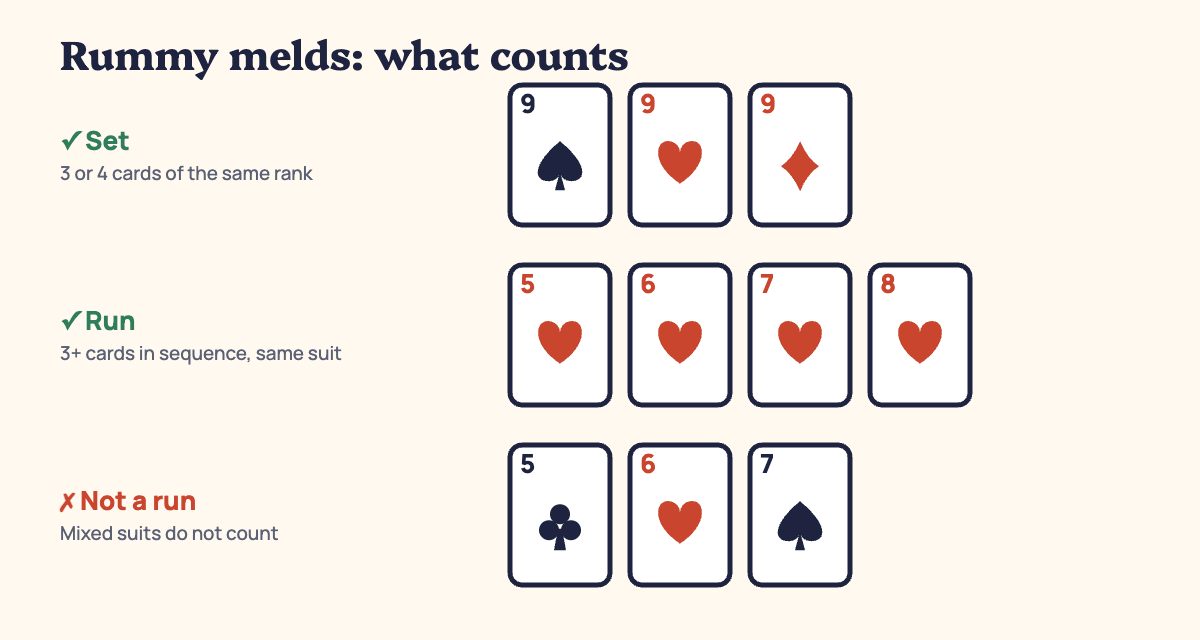
- Meld: a group of cards you lay face up on the table, either a set or a run.
- Set: three or four cards of the same rank, like three 9s.
- Run (sequence): three or more cards in a row of the same suit, like 5-6-7-8 of hearts.
- Lay off: add a card from your hand to a meld already on the table.
- Stock: the face-down draw pile.
- Discard pile: the face-up pile next to the stock.
How many cards to deal in Rummy
| Players | Cards each |
|---|---|
| 2 | 10 |
| 3 or 4 | 7 |
| 5 or 6 | 6 |
Card values for scoring: aces are 1 point, number cards are worth their number, and jacks, queens and kings are 10 points each. In standard Rummy, aces are low, so A-2-3 is a run but Q-K-A is not.
How to set up Rummy
- Choose a dealer. Shuffle and deal cards one at a time, clockwise, using the table above.
- Place the remaining cards face down in the center as the stock.
- Turn the top card of the stock face up beside it to start the discard pile.
How to play Rummy, step by step
The player to the dealer’s left goes first. Each turn has three parts:
- Draw one card, either the top card of the stock or the top card of the discard pile.
- Meld or lay off (optional). Lay down any sets or runs you have, and add cards to melds already on the table, including other players’ melds.
- Discard one card face up onto the discard pile. If you drew from the discard pile, you cannot throw the same card back on that turn.
Play continues clockwise. If the stock runs out, turn the discard pile over (without shuffling) to make a new stock.
How to win a hand
You go out when you get rid of your last card, either by melding it or discarding it. The hand ends immediately.
The winner scores the total value of the cards left in every other player’s hand. Then reshuffle, pass the deal to the left and play again. Play to an agreed target, such as 100 points, or play a set number of hands and add up the totals.
Going rummy: if you meld your whole hand in one turn without having melded before, many families double your score for that hand.
How to play Rummy with 2 players
With two players, deal 10 cards each and play exactly as above. Two-player Rummy moves faster and rewards watching your opponent’s discards: if they pick up a 7 from the discard pile, think twice before throwing them another 7. If you want a strategic two-player version, Gin Rummy is the classic choice.
How to play Rummy 500
Rummy 500 is a popular version where you score points for every card you meld, not just for going out.
- Deal: 13 cards each with 2 players, 7 cards each with 3 or more.
- Spread the discard pile so every card in it is visible.
- Draw from the stock, or take any card from the discard pile, as long as you also take every card on top of it and use that card in a meld on the same turn.
- Meld, lay off and discard as in standard Rummy.
- Scoring: when a player goes out, everyone adds up the cards they melded and subtracts the cards left in their hand. Aces count 15 (or 1 when used low in A-2-3), face cards 10, number cards face value.
- Winning: the first player to reach 500 points wins.
The spread discard pile is what makes Rummy 500 different: a pile of cards can be a treasure chest or a trap full of cards you cannot use.
Rummy strategy tips
- Keep cards that can go two ways. A 7 of hearts can join a set of 7s or a run of hearts, so it is more flexible than a lonely king.
- Dump high cards early. If an opponent goes out, the face cards left in your hand cost 10 points each.
- Watch the discard pile. What other players pick up tells you what they are collecting; avoid feeding them.
- Do not meld too early. Holding melds in your hand keeps your plans hidden, but hold too long and you get caught with a full hand of points.
- Lay off on other players’ melds. It is often the fastest way to shrink your hand.
Rummy vs Gin Rummy: what is the difference?
In standard Rummy, players lay melds on the table during the game and can lay off on anyone’s melds. In Gin Rummy, there are always two players, nobody melds until the end, and a player can end the hand by “knocking” when their unmatched cards total 10 points or less.
Rummy FAQ
How many cards do you get in Rummy?
Ten each with 2 players, 7 each with 3 or 4 players, and 6 each with 5 or 6 players. In Rummy 500, two players get 13 each.
Can you lay off on other players’ melds?
Yes. In standard Rummy and Rummy 500, you can add cards to any meld on the table.
Is an ace high or low in Rummy?
Usually low: A-2-3 is a valid run, but Q-K-A is not. Some families allow aces high too; agree before you start.
Do you have to discard to go out in Rummy?
Rules vary. In most home games you can go out by melding your last card or by discarding it. Some families require a final discard.
What happens when the stock runs out?
Turn the discard pile over, without shuffling, to make a new stock and keep playing.
How do you win at Rummy?
Form sets and runs as quickly as you can, keep your hand low in points, and go out before your opponents. In multi-hand games, the first player to the target score wins.
More classic card games: how to play Spades and how to play Spoons.
Leave a Reply