
The best card games for kids with a regular deck are the ones a child can learn in one round: Memory, Snap, Go Fish and Old Maid for preschoolers; War, Slapjack and Crazy Eights for early readers; and Spoons, Thirty-One and Rummy once kids can add up cards and plan a move ahead. All you need is one standard 52-card deck.
Below are 16 card games for kids sorted by age, each with a short goal and simple rules. Treat the ages as a starting point, not a rule.
Card games for kids at a glance
| Game | Ages | Players | What kids practice |
|---|---|---|---|
| Memory (Concentration) | 3+ | 1–6 | Matching, memory |
| Snap | 4+ | 2–6 | Matching, quick reactions |
| Go Fish | 4+ | 2–6 | Asking, number names |
| Old Maid | 4+ | 2–6 | Pairs, taking turns |
| War | 5+ | 2 | Comparing numbers |
| Slapjack | 5+ | 2–6 | Reaction speed |
| Crazy Eights | 5+ | 2–6 | Suits and numbers |
| Beggar My Neighbor | 5+ | 2–4 | Counting, patience |
| Clock Solitaire | 5+ | 1 | Number order, telling time |
| Spoons | 7+ | 3–8 | Sets, fast thinking |
| Kings in the Corner | 7+ | 2–4 | Sequences, red/black |
| I Doubt It | 7+ | 3–6 | Bluffing, counting |
| Thirty-One | 7+ | 2–7 | Addition to 31 |
| Egyptian Ratscrew | 8+ | 2–6 | Patterns, reactions |
| Rummy | 8+ | 2–6 | Sets and runs, planning |
| Spades | 10+ | 4 | Teamwork, trick-taking |
Quick terms: rank is the number or picture on a card (7, Queen) and suit is the symbol (hearts, diamonds, clubs, spades). Unless a game says otherwise, Jack, Queen and King rank 11, 12 and 13, and play moves clockwise.
Easy card games for kids ages 3 to 5
These first games need no reading and very little counting.
1. Memory (Concentration)
Goal: Collect the most matching pairs.
- Choose 8 to 12 pairs for young kids (for example, both red 5s and both black 5s). Use the full deck for older kids.
- Shuffle and lay the cards face down in rows.
- On your turn, flip any two cards. If they match, keep the pair and go again. If not, turn them back over.
- When all cards are gone, the player with the most pairs wins.
2. Snap
Goal: Win all the cards by spotting matches first.
- Deal the whole deck face down. Players keep their piles without looking.
- Going around the table, each player turns their top card face up onto their own face-up pile.
- When the top cards of any two face-up piles match in rank, the first to shout “Snap!” wins both piles.
- If someone calls “Snap!” by mistake, they give one card to each other player.
- Players who run out of cards are out. The last player with cards wins.
3. Go Fish
Goal: Collect the most “books” (all four cards of one rank).
- Deal 7 cards each for 2 or 3 players, or 5 cards each for 4 or more. Spread the rest face down in the middle as the “pond.”
- On your turn, ask one player for a rank you already hold: “Do you have any 9s?”
- If they do, they hand over every 9 they have and you ask again.
- If they don’t, they say “Go fish!” and you draw one card from the pond. If you happen to draw the rank you asked for, show it and go again. Otherwise, your turn ends.
- Lay down each book of four as soon as you have it.
- If your hand runs out, draw from the pond. When all 13 books are made, the most books wins.
For very young players, make pairs instead of books of four.
4. Old Maid
Goal: Don’t get stuck with the odd Queen at the end.
- Take one Queen out of the deck, so one of the three Queens left can never make a pair.
- Deal all the cards (uneven hands are fine).
- Everyone lays down any pairs (two cards of the same rank) from their hand.
- Take turns drawing one card, face down, from the hand of the player on your left. If it makes a pair, lay the pair down.
- Players who run out of cards are safe. The player left holding the last Queen is the “Old Maid.”
Some families remove a Jack instead (“Old Jack”).
Card games for kids ages 5 to 7
These games build number sense without feeling like homework.
5. War
Goal: Win all 52 cards.
- Deal the deck evenly between two players, face down. Don’t look at your cards.
- Both players flip their top card at the same time. The higher card wins both, and the winner puts them at the bottom of their pile. Aces are high.
- If the cards tie, it’s “war.” Each player puts one card face down and then one card face up. The higher face-up card takes all the cards in the middle. Many families put three cards face down instead of one. Agree before you start.
- If a player can’t finish a war because they’re out of cards, they lose.
- The player who collects every card wins.
War can run long, so set a 10-minute timer and count piles when it rings. For math practice, try Addition War: each player flips two cards and the higher total wins.
6. Slapjack
Goal: Win all the cards by slapping Jacks first.
- Deal the whole deck face down. Players keep their piles without looking.
- In turn, each player flips their top card face up onto one middle pile, turning it away from themselves.
- When a Jack appears, everyone races to slap it. The first hand on the Jack wins the whole pile.
- Slap the wrong card and you give one card to the player who turned it.
- If you run out of cards, you can stay in by slapping the next Jack. Miss it and you’re out. The player with all the cards wins.
7. Crazy Eights
Goal: Be the first to play all your cards.
- Deal 7 cards each for 2 players, or 5 each for 3 or more. Place the rest face down as the draw pile and turn the top card face up to start the discard pile.
- On your turn, play one card that matches the top discard by suit or rank. A 6 of hearts can go on any heart or any 6.
- Eights are wild. Play an 8 any time and name the suit the next player must follow.
- If you can’t play, draw until you can (some families draw one card and pass).
- The first player to empty their hand wins.
8. Beggar My Neighbor
Goal: Win all the cards. Kids also know this one as “Strip Jack Naked.”
- Deal the deck evenly. Players keep their piles face down.
- Take turns turning one card face up onto a center pile.
- When someone turns an Ace, King, Queen or Jack, the next player must “pay”: 4 cards for an Ace, 3 for a King, 2 for a Queen, 1 for a Jack, turned one at a time.
- If one of those paying cards is also an Ace or face card, the payment stops and the next player must pay for that card instead.
- If the payment finishes with no Ace or face card, the player who played the last Ace or face card wins the whole center pile.
- The player who ends up with every card wins.
9. Clock Solitaire
Goal: Turn every card face up before the fourth King appears (one player).
- Deal the deck into 13 piles of four face-down cards. Arrange 12 piles in a circle like a clock: Ace at 1 o’clock, 2 at 2 o’clock, and so on up to Queen at 12. Put the 13th pile, for Kings, in the middle.
- Turn over the top card of the King pile. Slide it face up under the pile with its number. A 5 goes under the 5 o’clock pile.
- Then turn over the top face-down card of that pile and do the same.
- Kings go face up under the center pile.
- When the fourth King turns up, the game ends. If every card is face up, you win.
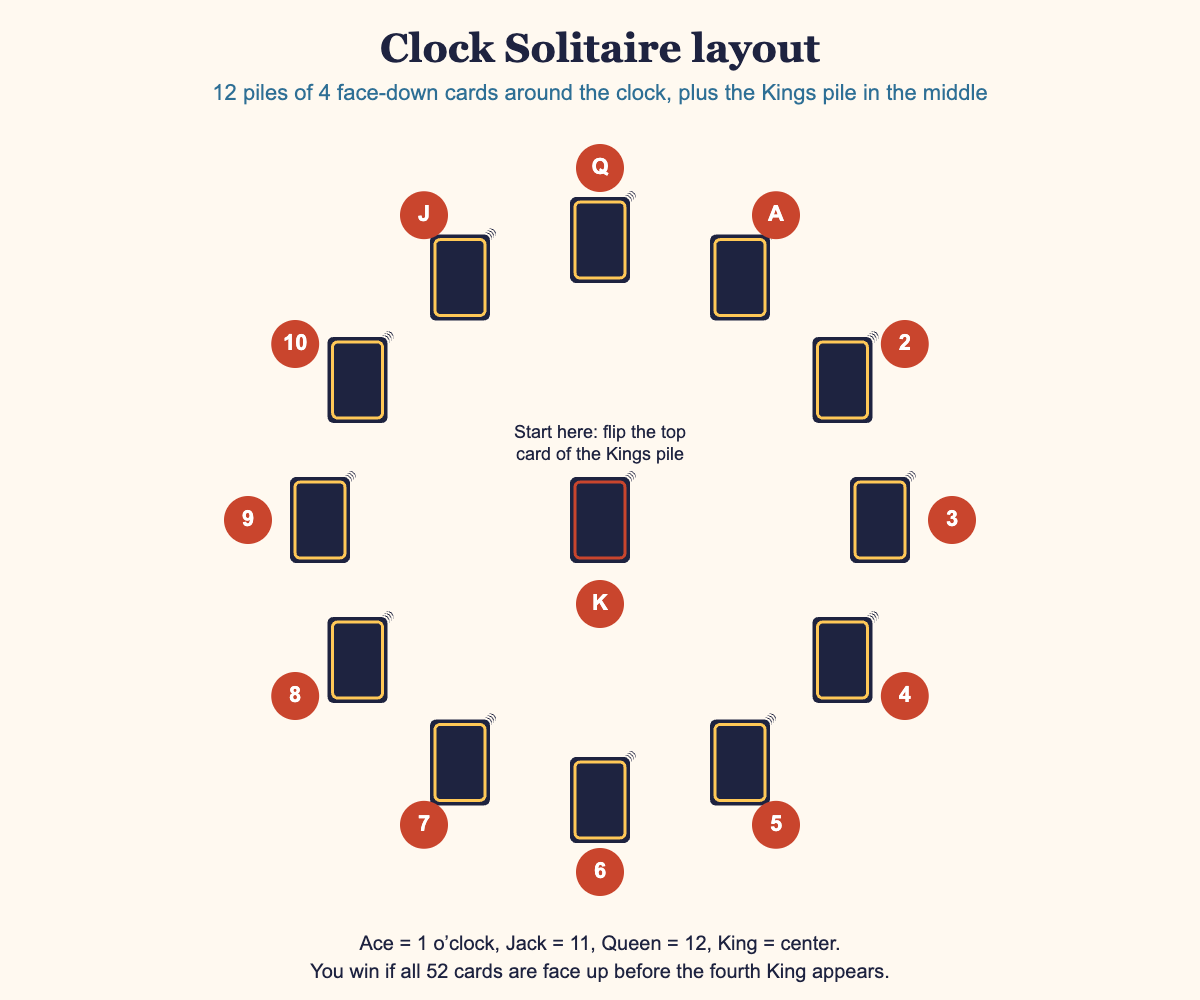
It’s all luck, but kids practice number order and the positions on a clock face.
Card games for kids ages 7 to 10
These add a little strategy, bluffing or quick addition.
10. Spoons
Goal: Grab a spoon before they’re gone.
Everyone holds four cards and passes cards quickly around the table. When someone collects four of a kind, they quietly take a spoon from the middle, everyone else grabs one, and the player left without a spoon gets a letter. There is one spoon fewer than players. See the full rules for how to play Spoons.
No spoons handy? Play Pig instead: the first player with four of a kind touches their nose, and the last person to notice is the Pig.
11. Kings in the Corner
Goal: Be the first to play all your cards.
Players build down in alternating colors (red 7 on a black 8) on piles around the deck, and Kings go in the corners. It’s like solitaire for a group. Read the full rules for Kings in the Corner.
12. I Doubt It
Goal: Get rid of all your cards, bluffing when you need to.
- Deal the whole deck. Uneven hands are fine.
- The first player puts one or more cards face down in the middle and says what they are, starting with Aces: “Two Aces.”
- The next player must play 2s, the next 3s, and so on up to Kings, then back to Aces.
- You can lie about what you put down. Any player can say “I doubt it!” before the next turn starts.
- Flip the cards over. If the player lied, they take the whole pile. If they told the truth, the doubter takes it.
- The first player with no cards left wins.
The same game is also known as “Cheat.”
13. Thirty-One
Goal: Get the highest total in one suit, up to 31.
- Deal 3 cards each. Put the rest face down as a draw pile and turn the top card face up to start a discard pile.
- Aces count 11, face cards count 10 and number cards count their number. Only cards of the same suit add together.
- On your turn, take the top card from the draw pile or the discard pile, then discard one card.
- When you think your hand will win, knock on the table instead of drawing. Every other player gets one more turn, and then everyone shows their cards.
- The lowest hand loses a life (each player starts with three). If someone holds exactly 31, they show it right away and everyone else loses a life.
- The last player with lives left wins.
It’s also called Scat or Blitz, and it’s great addition practice.
14. Egyptian Ratscrew
Goal: Win every card using luck and fast hands.
It plays like Beggar My Neighbor, plus slapping: anyone can slap the center pile when the top two cards match (a double) or when two matching cards have one card between them (a sandwich). The first slapper wins the pile. A wrong slap costs one card, placed under the pile.
Card games for older kids and tweens
15. Rummy
Goal: Lay down all your cards in sets (three or four of a kind) and runs (three or more in a row in one suit).
Each turn you draw one card and discard one, building melds as you go, so kids learn to plan ahead. See our beginner guide on how to play Rummy.
16. Spades
Goal: Win the number of tricks your team bid.
Spades is a four-player partner game where spades beat every other suit. Pair a new player with an adult for the first few hands. Learn it with our guide on how to play Spades.
Best card games for kids by number of players
- One player: Clock Solitaire, Memory.
- Two players: War, Crazy Eights, Kings in the Corner, Rummy. For more ideas, see our list of card games for 2 people.
- Three players: Go Fish, Old Maid, Spoons, Thirty-One, I Doubt It.
- Four or more: Snap, Slapjack, Crazy Eights, Spoons, Spades (exactly four).
Tips for teaching card games to kids
- Play one open hand. In the first round, everyone plays face up so you can talk through choices.
- Teach one rule at a time. Add special cards, like wild eights, in the second game.
- Shrink the deck. For preschoolers, remove face cards or use only two suits.
- Help small hands. A card holder, or a shoebox lid with a slot cut in it, keeps cards hidden and upright.
- Keep games short. Three quick rounds beat one long game that ends in tears.
For more ways to plan the night, see our family game night ideas, or browse all our card games.
Card games for kids FAQ
What is the easiest card game for kids?
Memory (Concentration) is the easiest: kids only remember where cards are and spot pairs. Snap and Go Fish are close behind, and all three suit many children from about age three or four.
What card games are good for 5-year-olds?
War, Go Fish, Old Maid, Snap, Slapjack and Crazy Eights suit most 5-year-olds: short turns, simple goals and lots of matching.
What card games can you play with a regular deck?
Every game on this list uses one standard 52-card deck: Go Fish, Old Maid, War, Slapjack, Crazy Eights, Spoons, I Doubt It, Thirty-One, Rummy, Spades and more. Spoons also needs a few spoons.
Which card games help kids with math?
Addition War, Thirty-One and Rummy give the most math practice, since kids add card values and compare totals. War and Clock Solitaire help younger kids with number order.
At what age can kids learn card games?
Many children can play matching games like Memory and Snap at around age three or four. Games with a full hand of cards, such as Go Fish and Crazy Eights, usually click between four and six, and strategy games like Rummy and Spades suit most kids from about eight to ten.
Sources and further reading
- Go Fish at Bicycle Cards: the playing card maker’s rules for a classic first card game.
- Slapjack at Bicycle Cards: rules for a fast slapping game young kids love.
Leave a Reply