
To play Gin Rummy, two players are each dealt 10 cards and take turns drawing and discarding to form melds: sets of the same rank and runs in the same suit. When your unmatched cards (deadwood) add up to 10 points or less, you can knock to end the hand, or you can hold out for gin, where every card is melded, for a bonus. Points from each hand add up until one player reaches 100.
Gin Rummy is one of the best card games for two people. A hand takes only a few minutes, the rules fit on an index card, and there is real skill in deciding when to knock. This guide covers the full Gin Rummy rules, from the deal and the first up-card to knocking, laying off, undercuts and end-of-game bonuses. You’ll also find versions for 3 and 4 players, Oklahoma Gin and tips for teaching kids.
Gin Rummy at a glance
| Item | Details |
|---|---|
| Players | 2 (versions for 3 or 4 below) |
| Ages | About 8 and up; younger kids can play on a team with an adult |
| You need | One standard 52-card deck (no jokers), paper and a pencil |
| Cards dealt | 10 each |
| Aces | Always low (A-2-3 is a run; Q-K-A is not) |
| Goal of a hand | Meld your cards and keep your deadwood low |
| Goal of the game | Be the first to 100 points, then add bonuses |
Gin Rummy terms to know
- Meld: a set or a run. A card can belong to only one meld at a time.
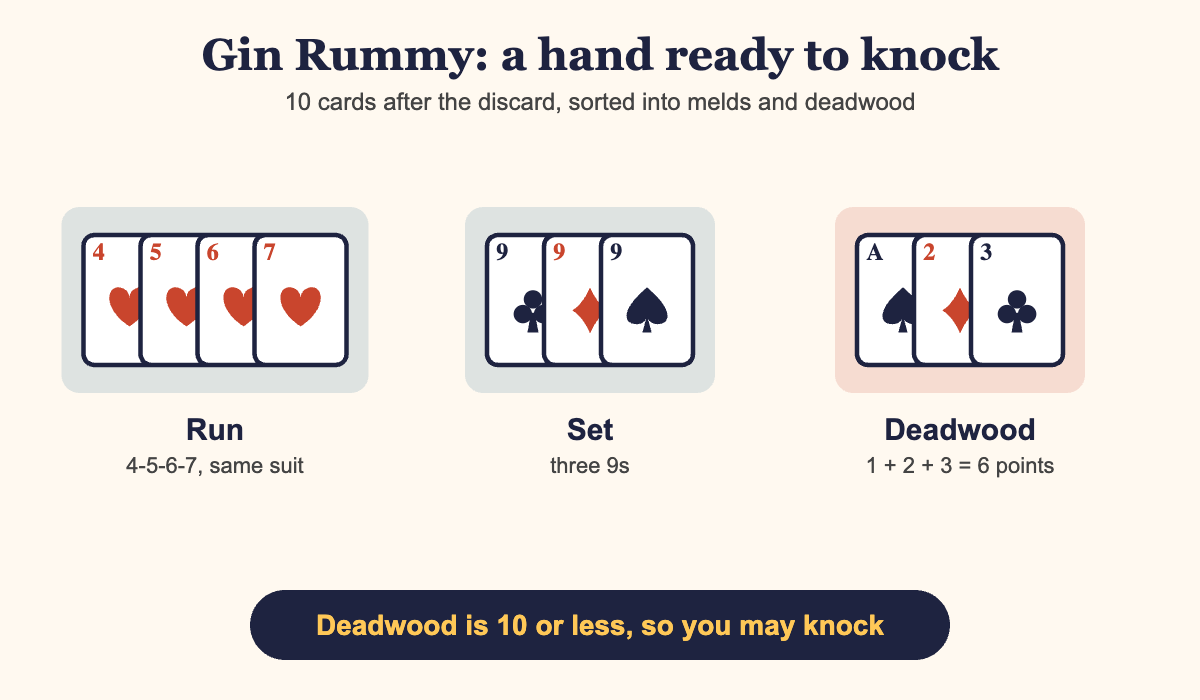
- Set: three or four cards of the same rank, like 9♣ 9♦ 9♠.
- Run: three or more cards of the same suit in order, like 4♥ 5♥ 6♥ 7♥.
- Deadwood: cards that are not in a meld. Aces count 1 point, number cards count their face value, and jacks, queens and kings count 10.
- Stock: the face-down draw pile.
- Up-card: the top card of the face-up discard pile.
- Knock: end the hand when your deadwood totals 10 points or less.
- Gin: knock with zero deadwood (all 10 cards melded).
- Lay off: after a knock, the opponent adds their loose cards to the knocker’s melds.
- Undercut: when the opponent’s deadwood is equal to or lower than the knocker’s.
- Box (line bonus): a bonus for each hand won, added at the end of the game.
Setup
- Pick the first dealer at random, for example by having each player cut the deck. Low card deals.
- Shuffle and deal 10 cards to each player, one at a time.
- Turn the 21st card face up to start the discard pile. This is the first up-card.
- Put the rest of the deck face down next to it as the stock.
- Each player picks up their hand and sorts it by suit and rank. Keep it hidden.
How to play Gin Rummy step by step
Every turn has two parts: draw one card, then discard one card. You always end your turn with 10 cards.
The first turn: the up-card offer
The first turn of each hand works a little differently.
- The non-dealer may take the first up-card or pass.
- If the non-dealer passes, the dealer may take it or pass.
- If both players pass, the non-dealer draws the top card of the stock.
- Whoever took a card finishes the turn by discarding, and normal play begins.
Normal turns
- Draw. Take either the top card of the stock (unseen) or the top card of the discard pile (the up-card).
- Meld in your hand. Rearrange your cards into sets and runs. In Gin Rummy, melds stay in your hand; you only lay them down when the hand ends.
- Discard. Put one card face up on the discard pile. If you took the up-card this turn, you must discard a different card.
- Knock or keep playing. If your deadwood is now 10 points or less, you may knock (see below). You never have to knock, even if you can.
- Play passes to your opponent.
What happens if the stock runs out?
If only two cards are left in the stock and the player who took the third-to-last card discards without knocking, the hand is a draw. No one scores, and the same dealer deals again.
How do you knock in Gin Rummy?
You knock by discarding your last card face down instead of face up, then spreading your hand on the table with melds and deadwood separated. Your deadwood must total 10 points or less. You can knock on any turn, including your first.
After you knock:
- You lay out your melds and your deadwood.
- Your opponent lays out their melds.
- Your opponent may lay off loose cards onto your melds, such as adding the fourth 9 to your set of 9s or the 8♥ to your 4-5-6-7♥ run.
- Both players count their remaining deadwood, and the hand is scored.
Two rules trip up new players. The knocker can never lay off cards on the opponent’s melds. And nobody can lay off onto deadwood: if you knock holding a pair of 2s, your opponent cannot add a third 2 to them.
Going gin
If all 10 cards in your hand are melded after you discard, you go gin. Your opponent may not lay off any cards, and you score a gin bonus on top of their deadwood. Most gin hands are a 4-card meld plus two 3-card melds, but two 5-card runs also count.
How do you score Gin Rummy?
After a knock, each player totals their deadwood. The lower total wins the hand and scores the difference, plus a bonus for gin or an undercut. Here are the standard values from published rules, along with values many families use instead.
| Result | Points scored | Common alternative |
|---|---|---|
| Knocker has less deadwood | The difference between the two counts, to the knocker | None |
| Undercut (opponent has equal or less deadwood) | The difference plus 10, to the opponent | Undercut bonus of 20 or 25 |
| Gin | Opponent’s full deadwood plus 20, to the player who went gin | Gin bonus of 25 |
A player who goes gin can never be undercut, even if the opponent also has zero deadwood.
Gin Rummy scoring examples
- Knock win: You knock with 6 points of deadwood (A♠ 2♦ 3♣). Your opponent holds Q♠ Q♥ Q♦, 2♠ 3♠ 4♠, 8♥, 9♥, K♣ and 5♣. They lay off 8♥ and then 9♥ on your heart run, leaving K♣ and 5♣ = 15. You score 15 − 6 = 9 points.
- Undercut: You knock with 8 points. After laying off, your opponent has 6. They score 2 + 10 = 12 points (or 2 + 25 = 27 with a 25-point undercut bonus).
- Gin: You go gin, and your opponent has 23 points of deadwood. You score 23 + 20 = 43 points (48 with a 25-point gin bonus).
Write each hand’s points in your column on the score sheet so you can see the running total and count hands won at the end.
How do you win a game of Gin Rummy?
Keep playing hands until one player’s running total reaches 100 points or more. Then add the end-of-game bonuses:
- Game bonus: 100 points to the player who reached 100.
- Shutout: if the loser did not win a single hand, the game bonus becomes 200. (Some players double the winner’s whole score instead.)
- Box or line bonus: 20 points to each player for every hand they won (25 in some homes). These bonuses do not count toward reaching 100.
The higher final score wins. For example, if Player A reached 104 points and won 5 hands, and Player B has 62 points from 3 hands, the final scores are A: 104 + 100 + 100 = 304 and B: 62 + 60 = 122.
Who deals next? Published rules differ. Pagat’s standard rules have the winner of the previous hand deal, some rule books have the loser deal, and many families simply alternate. Agree before you start.
How to play Gin Rummy with 2 players
Gin Rummy is a two-player game by design, so the rules above are the 2-player rules. Each player gets 10 cards, the non-dealer plays first, and you play to 100. If you want a shorter session, play to 50 and skip the bonuses.
How to play Gin Rummy with 3 players
With three people, only two play each hand. The dealer deals 10 cards to each of the other two players and sits out. The loser of each hand deals the next one, so the next hand is played between the winner and the player who just dealt. Each player keeps their own score.
How to play Gin Rummy with 4 players
Four people play as two teams of two. Each player plays a separate 2-player game against one member of the other team, and you switch opponents each hand. If both players on a team win their hands, the team scores both totals. If each team wins one hand, the team with the higher score gets the difference. The first team to 125 points wins.
With 5 or more players, Gin Rummy gets slow because only two people can play each game. For bigger groups, regular Rummy works better, or try a pick from our card games for large groups.
Gin Rummy variations
Oklahoma Gin
The value of the first up-card sets the most deadwood you can knock with. If a 7 is turned up, you need 7 points or less to knock; face cards mean 10. If the up-card is a spade, that hand’s score is doubled. Games usually go to 150. Some players say an ace up-card means you can only win the hand by going gin.
Hollywood Gin
Hollywood Gin keeps three games going at once on one score sheet. In the usual method, your first winning hand scores in Game 1, your second winning hand scores in Games 1 and 2, and your third and later winning hands score in all three games. Each game ends separately when someone reaches 100.
7-card Gin Rummy
Some families teach a shorter version with 7 cards each, especially for kids. There is no single standard rule set for it. One simple way: deal 7 cards each, play normal draw-and-discard turns, and end the hand when someone can meld all their cards (for example a set of 3 and a run of 4).
Other house rules
- Jokers: traditional Gin Rummy uses no jokers. Some families add two jokers as wild cards to make melds easier.
- Big gin: some players award a bigger bonus if all 11 cards in your hand are melded right after you draw, so you don’t need to discard.
- Lower knock limit: advanced players sometimes require 5 points or less to knock.
Gin Rummy vs. Rummy: what’s the difference?
In regular Rummy you lay melds on the table during the game and try to get rid of every card. In Gin Rummy you keep your melds in your hand, and the hand ends when someone knocks with 10 points or less of deadwood or goes gin. Gin Rummy is mainly a 2-player game, while basic Rummy is often played by 2 to 6 people. Our guide to regular Rummy covers that game step by step.
Gin Rummy strategy tips
- Dump high deadwood early. Unmatched kings, queens and jacks cost 10 points each if your opponent knocks.
- Take the up-card only when it helps. Picking it up tells your opponent what you are collecting.
- Watch the discard pile. Cards your opponent throws away hint at what they don’t need, and cards they pick up show what they do.
- Keep flexible cards. Middle cards like 6s, 7s and 8s can join runs from both directions.
- Knock early when the hand is young. A quick knock with low deadwood often beats waiting, because your opponent has had less time to build melds.
- Think about layoffs. Before knocking, check which of your melds your opponent could add to.
Teaching Gin Rummy to kids
Gin Rummy is a good next step for kids who already enjoy simpler games from our card games for kids list.
- Play the first few hands with cards face up so you can talk through each choice.
- Start with gin only (no knocking), then add knocking once melds feel easy.
- Let kids keep score. Adding deadwood is quick mental math practice.
- Play to 50 instead of 100 for a shorter game.
Looking for more games for two? See our list of card games for 2 people, or browse all card games.
Gin Rummy FAQ
How many cards do you deal in Gin Rummy for 2 players?
Deal 10 cards to each player. The 21st card is turned face up to start the discard pile, and the rest of the deck becomes the stock.
Can you knock on your first turn in Gin Rummy?
Yes. If your deadwood is 10 points or less after you draw and discard, you can knock on any turn, including the first.
Can you pick up a discard and throw it right back?
No. If you take the top card of the discard pile, you must discard a different card that turn. You may discard it on a later turn.
Is the ace high or low in Gin Rummy?
The ace is always low. It counts 1 point as deadwood, and A-2-3 is a valid run, but Q-K-A is not.
What happens if both players have the same deadwood after a knock?
That counts as an undercut. The knocker’s opponent scores the undercut bonus (10 in standard rules), since the difference is zero.
Can you play Gin Rummy with jokers?
Standard Gin Rummy uses a 52-card deck with no jokers. Using jokers as wild cards is a house rule, so agree on it before you deal.
Sources and further reading
- Gin Rummy rules at Pagat: the long-standing reference for traditional card game rules, including scoring variations.
- Gin Rummy at Bicycle Cards: the playing card maker’s own rules page.
Leave a Reply